Jump to a question in this guide
- Which change are you actually considering?
- What happens if you renew with the present lender?
- What makes a lender switch different from a renewal?
- What does refinancing add to the debt?
- Why does breaking the present term need a dated payout?
- Could waiting, porting or blending meet the same need?
- How do you compare offers over the same period?
- Where do registration, related debts and cash timing fit?
- What does a fictional comparison reveal?
- Which answers should you obtain before committing?
- Name the actual change and obtain dated current and proposed borrowing records.
- Compare payments, charges and remaining debt over the same horizon; a lower payment alone is not a cost finding.
- Keep lender approval, registered security, cash timing and property-condition decisions separately visible.
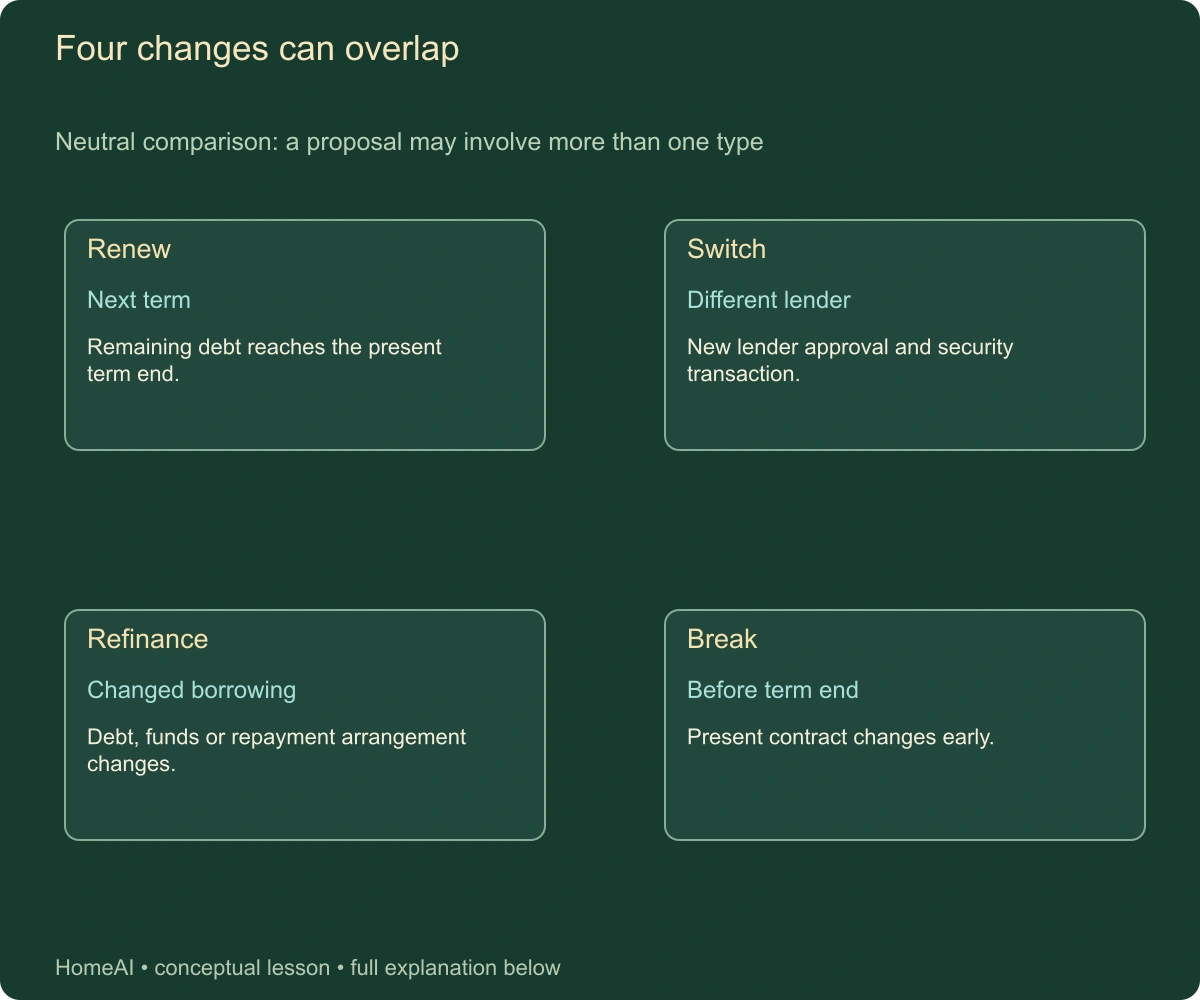
Four independent comparison boxes name renewal, switching, refinancing and breaking. Their positions imply no sequence. A switch or refinance may also break the current contract if undertaken before its term ends; renewal can coincide with a switch at maturity.
About this illustration
No product approval, contract treatment or price is supplied. This is a conceptual teaching model, not an assessment of your home.
6 picture lessons appear beside the questions in this guide. Use them to understand the explanation, then consider what it means for your home.
Which change are you actually considering?
Renewing sets the next contract for debt that remains at the end of a mortgage term. Switching moves borrowing to another lender. Refinancing changes the borrowing arrangement, potentially adding debt or changing its repayment schedule. Breaking ends or changes the present contract before its agreed term finishes. These words overlap in real proposals: a switch before maturity may also break the old contract, while a refinance can happen with the current lender.
Start with your purpose in ordinary language. Perhaps the term is ending, you plan to move, you need funds for an identified repair, or the current payment no longer fits household income. The useful comparison is between workable ways to meet that purpose. A lower advertised rate does not establish that a new loan will fund the required work, arrive on time or reduce the household’s total cost.
This guide builds the decision after you understand principal, interest, term and amortization. The established mortgage-structure guide teaches those parts. Here the question is what changes between the current arrangement and each real proposal: opening debt, cash required, payment, remaining balance, flexibility and timing. Keep property-condition evidence separate. A loan approval does not determine whether the roof repair scope or suite conversion is technically sound.
Create one current-state record before collecting offers. Include the lender, term-end date, current balance, remaining repayment assumptions, rate/payment type, registration information and any other borrowing secured by the same property. Record the date of the statement. Then identify the proposed completion date. A quotation built for a different date or debt amount may answer a different question.
Four changes can overlap
Four independent comparison boxes name renewal, switching, refinancing and breaking. Their positions imply no sequence. A switch or refinance may also break the current contract if undertaken before its term ends; renewal can coincide with a switch at maturity.
Numbers identify the parts explained below.
- Renew
Next term. Remaining debt reaches the present term end.
- Switch
Different lender. New lender approval and security transaction.
- Refinance
Changed borrowing. Debt, funds or repayment arrangement changes.
What does this illustration leave out?
No product approval, contract treatment or price is supplied. This illustration explains an idea. It is not an installation guide.
Which changes occur in the actual dated proposal?
Explore this with HomeAI ↗Opens an editable question. Nothing is sent until you choose to send it.Name what changes
- RenewNext contract at term end.
- SwitchA different lender and its approval.
- RefinanceChanged borrowing, potentially debt and schedule.
- BreakEarly end or change of the present term.
Descriptions can overlap; the actual proposal and contract determine treatment.
Further reading: FCAC — Renewing your mortgage; FCAC — Breaking your mortgage contract; FCAC — Borrowing against home equity.
Read the complete figure
Four changes can overlap
Neutral comparison: a proposal may involve more than one type
- Renew
- Next term. Remaining debt reaches the present term end.
- Switch
- Different lender. New lender approval and security transaction.
- Refinance
- Changed borrowing. Debt, funds or repayment arrangement changes.
- Break
- Before term end. Present contract changes early.
Four independent comparison boxes name renewal, switching, refinancing and breaking. Their positions imply no sequence. A switch or refinance may also break the current contract if undertaken before its term ends; renewal can coincide with a switch at maturity.
What remains unknown: No product approval, contract treatment or price is supplied.
A useful question: Which changes occur in the actual dated proposal?
Conceptual teaching diagram. Complete labels and their meanings follow in static text.
What happens if you renew with the present lender?
At term end, the remaining mortgage needs its next arrangement unless it is repaid in full. The renewal offer normally identifies a new term, rate and payment conditions. Its familiarity can make it easy to accept without reviewing how household plans have changed. Compare the actual renewal against your purpose and against other feasible proposals, including what happens if you do not actively choose.
FCAC explains renewal statements and notice duties for federally regulated institutions. Do not treat a federal banking notice rule as the universal timetable for every Canadian lender. Read your own documents and ask the applicable institution about the process. An automatic-renewal provision needs particular attention: doing nothing can still produce a new arrangement with conditions you have not compared.
Ask for a written illustration using the balance expected at renewal and the intended payment frequency. Separate a rate reduction from an amortization extension or other restructuring. A payment can fall because repayment is spread over more time, even when that change increases interest paid over the longer horizon. Keep any tax collection or optional insurance charge separate from the debt payment in the comparison.
Record which parts of the current arrangement continue and which are replaced. Prepayment privileges, portability conditions and any optional products deserve their own confirmation. A conversation saying that everything remains the same is less useful than identified terms in the actual renewal documents. If you expect a lump sum, sale or further borrowing, ask how that particular event would work before signing.
What makes a lender switch different from a renewal?
A new lender makes its own approval decision. Existing borrowing and a timely payment history do not, by themselves, establish that every new lender will accept the application or the property. Request the actual application requirements and outstanding conditions early enough to understand the decision. Keep an indicative quotation, a conditional approval and a completed funded transaction as different stages.
A switch also changes the registered-security enquiry. Ask your lawyer or, where appropriate, notary and both lenders how the existing arrangement will be transferred, discharged or replaced. FCAC identifies possible appraisal, registration, transfer, discharge and administration costs. Those are categories to investigate, not a bill that every switch must contain. Ask which party pays each cost and whether any reimbursement has conditions.
The proposed lender may offer to cover some charges. Record whether the amount is paid directly, reimbursed later, added to the loan or conditional on keeping the mortgage. An offer to cover costs should not disappear into a headline rate comparison. It changes the household’s cash timing, and a future early departure may have separate consequences under the actual terms.
Check existing mortgage-loan insurance records with the lenders if applicable. FCAC notes that a changed loan amount or extended amortization can raise new insurance questions. This guide supplies no personal eligibility verdict or premium calculation. Give the new lender accurate current information and obtain a written explanation of the proposed treatment rather than assuming that an ordinary switch and additional borrowing are identical.
A quote is one stage of a switch
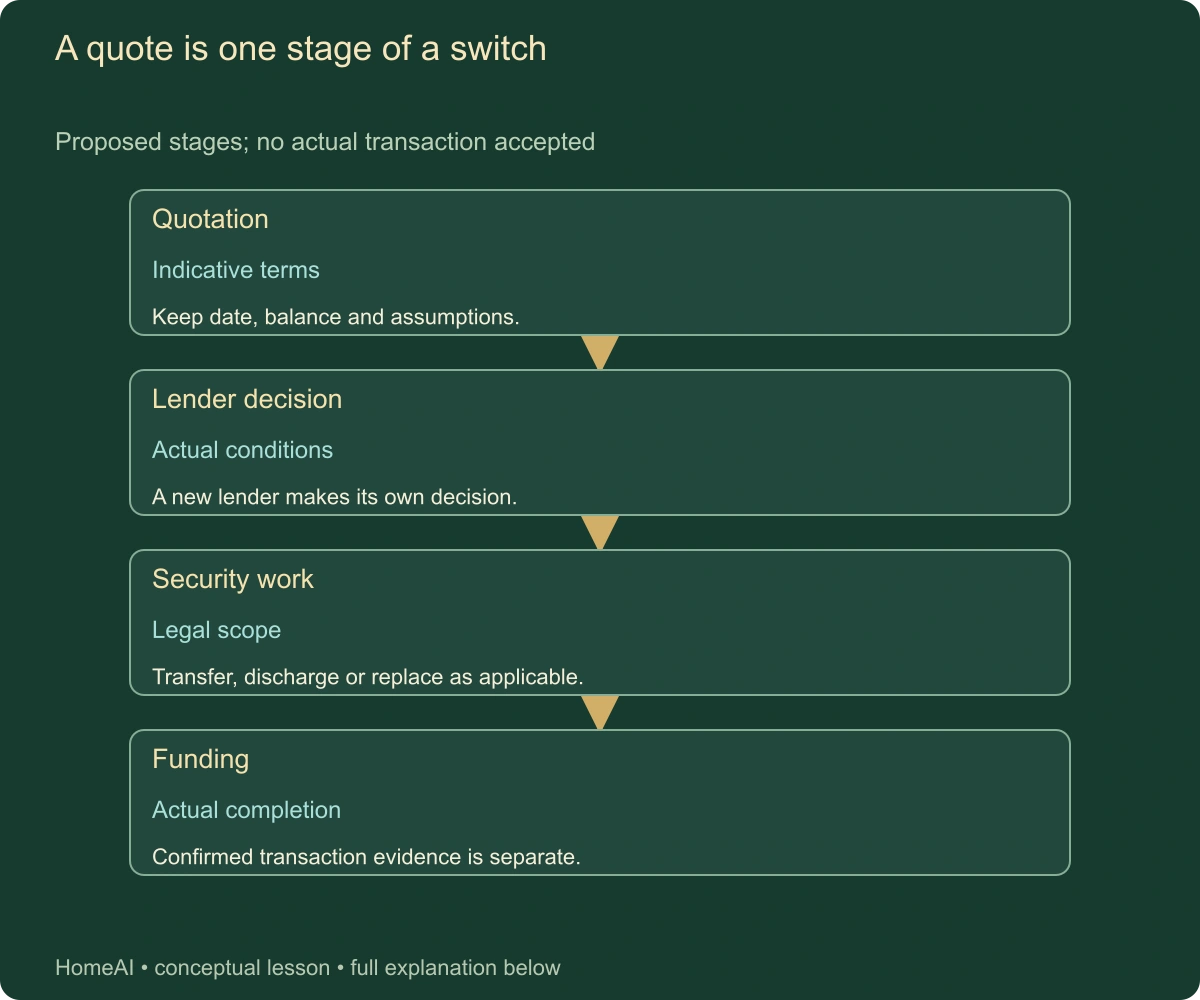
The stages connect an indicative offer with approval, registered-security work and actual funding. Each has its own evidence, so an attractive quote does not establish completion.
Numbers identify the parts explained below.
- Quotation
Indicative terms. Keep date, balance and assumptions.
- Lender decision
Actual conditions. A new lender makes its own decision.
- Security work
Legal scope. Transfer, discharge or replace as applicable.
What does this illustration leave out?
No required order for every lender, approval or guaranteed funding date. This illustration explains an idea. It is not an installation guide.
What condition remains between this quotation and actual funding?
Explore this with HomeAI ↗Opens an editable question. Nothing is sent until you choose to send it.Read the complete figure
A quote is one stage of a switch
Proposed stages; no actual transaction accepted
- Quotation
- Indicative terms. Keep date, balance and assumptions.
- Lender decision
- Actual conditions. A new lender makes its own decision.
- Security work
- Legal scope. Transfer, discharge or replace as applicable.
- Funding
- Actual completion. Confirmed transaction evidence is separate.
- Quotation → Lender decision: Application.
- Lender decision → Security work: Remaining conditions.
- Security work → Funding: Complete requirements.
The stages connect an indicative offer with approval, registered-security work and actual funding. Each has its own evidence, so an attractive quote does not establish completion.
What remains unknown: No required order for every lender, approval or guaranteed funding date.
A useful question: What condition remains between this quotation and actual funding?
Conceptual teaching diagram. Complete labels and their meanings follow in static text.
What does refinancing add to the debt?
Home equity is the difference between the relevant home value and borrowing secured against it. It is not money already sitting in your account. Obtaining funds from that equity means taking on borrowing under a new or changed arrangement. The lender may require an appraisal and other assessment. The amount available, conditions and costs depend on the actual application; an online property estimate cannot approve it.
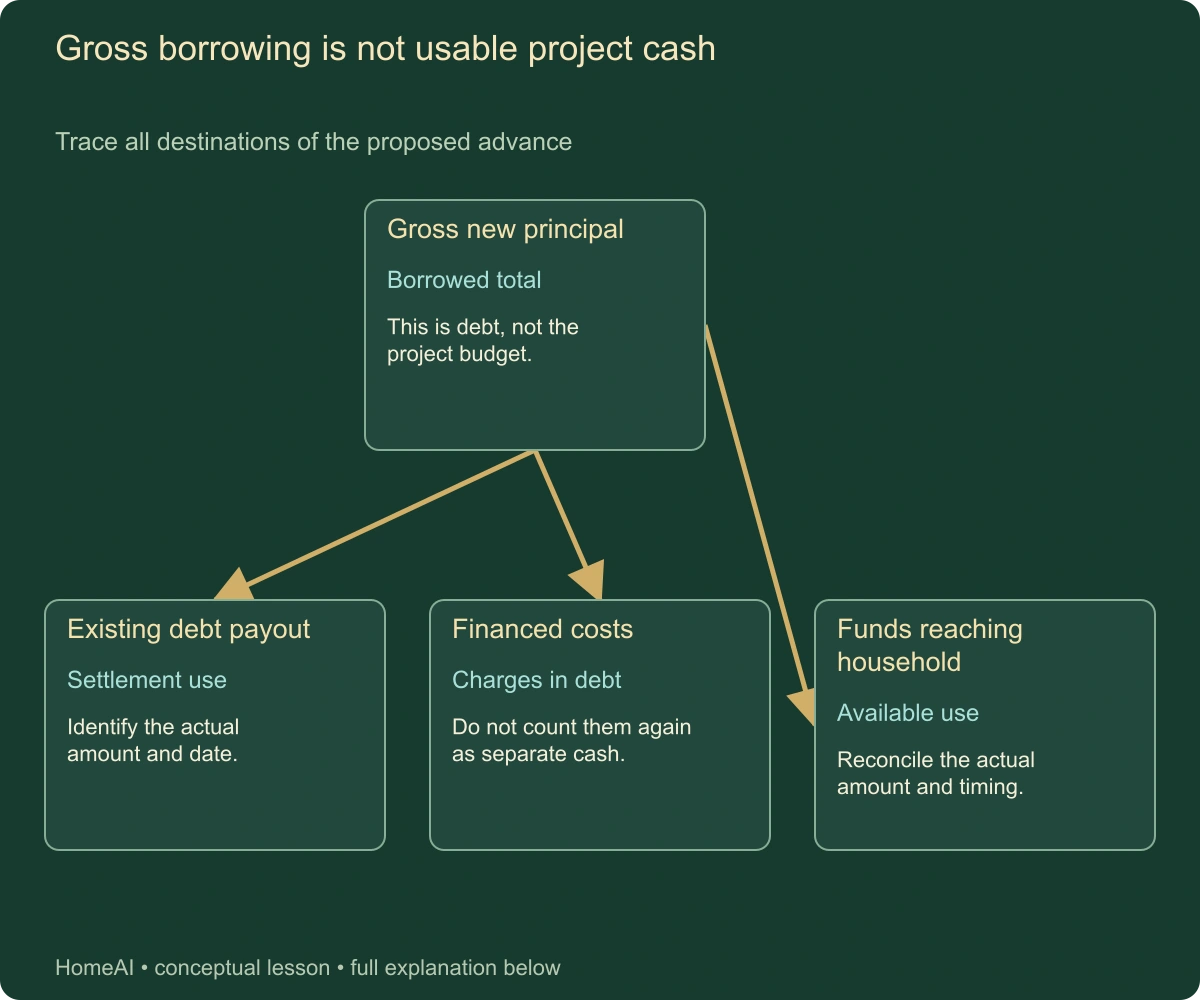
Trace the proposed advance to its uses. Some money may repay the existing mortgage, some may settle other debts, some may cover agreed charges and some may reach the household for a project. The gross new principal is therefore different from the usable cash. Ask for a written reconciliation that shows what is financed and what must be paid separately, without treating a rough loan amount as the project budget.
Moving other debt into borrowing secured by the home can change the risk as well as the interest rate. FCAC explains that failure to repay secured borrowing can have serious consequences for the home. A lower monthly total may also reflect a longer repayment period. Compare the total debt trajectory and household repayment plan, not simply the first payment after consolidation.
A repair proposal should have its own technical scope, permissions, contingencies and payment schedule. If funds are intended for sewer replacement, for example, the required investigation and access questions remain even if the financing is approved. Ask the appropriate financial and technical professionals how uncertain cost or timing affects the plan. Do not turn a lender’s valuation into an inspection result or a guaranteed project allowance.
Gross borrowing is not usable project cash
The new advance divides among settlement, financed charges and household funds. The household therefore cannot treat the full loan amount as money available for a repair.
Numbers identify the parts explained below.
- Gross new principal
Borrowed total. This is debt, not the project budget.
- Existing debt payout
Settlement use. Identify the actual amount and date.
- Financed costs
Charges in debt. Do not count them again as separate cash.
What does this illustration leave out?
No actual advance, qualification, value or fee amount. This illustration explains an idea. It is not an installation guide.
How does the actual advance reconcile to each destination?
Explore this with HomeAI ↗Opens an editable question. Nothing is sent until you choose to send it.Read the complete figure
Gross borrowing is not usable project cash
Trace all destinations of the proposed advance
- Gross new principal
- Borrowed total. This is debt, not the project budget.
- Existing debt payout
- Settlement use. Identify the actual amount and date.
- Financed costs
- Charges in debt. Do not count them again as separate cash.
- Funds reaching household
- Available use. Reconcile the actual amount and timing.
- Gross new principal → Existing debt payout: Part of advance.
- Gross new principal → Financed costs: If financed.
- Gross new principal → Funds reaching household: Remaining funds.
The new advance divides among settlement, financed charges and household funds. The household therefore cannot treat the full loan amount as money available for a repair.
What remains unknown: No actual advance, qualification, value or fee amount.
A useful question: How does the actual advance reconcile to each destination?
Conceptual teaching diagram. Complete labels and their meanings follow in static text.
Why does breaking the present term need a dated payout?
An open mortgage and a closed mortgage have different early-repayment conditions. A prepayment privilege is a specific allowance for extra repayment under the contract. It is not a general promise that the entire loan can be ended without cost. An early sale, lender switch or repayment beyond an allowance can raise a prepayment-charge question. Read the actual event and timing with the lender.
FCAC explains that penalty methods vary. An interest-rate differential compares specified interest calculations under the lender’s method; it is not simply the difference between the rate you pay and a rate seen in an advertisement. The comparison rate, original discount, remaining period and relevant balance can matter. Avoid substituting a generic online calculation for the actual contract explanation.
Request a dated written payout or cost statement appropriate to the proposed transaction. Ask which amounts are principal, interest to the relevant date, prepayment charge, other fees and any cashback repayment. Confirm the quotation’s expiry and what changes if completion moves. A calculator estimate may help you decide whether to investigate; it does not settle the money required on closing day.
Do not make an extra payment on the assumption that it will automatically reduce the charge in the expected way. FCAC notes that some lenders restrict prepayment near a break date. Ask how a proposed payment would be treated under your current allowance before acting. The goal is a transparent cost explanation, including uncertainty, rather than a supposedly universal method for avoiding charges.
The date belongs beside the payout
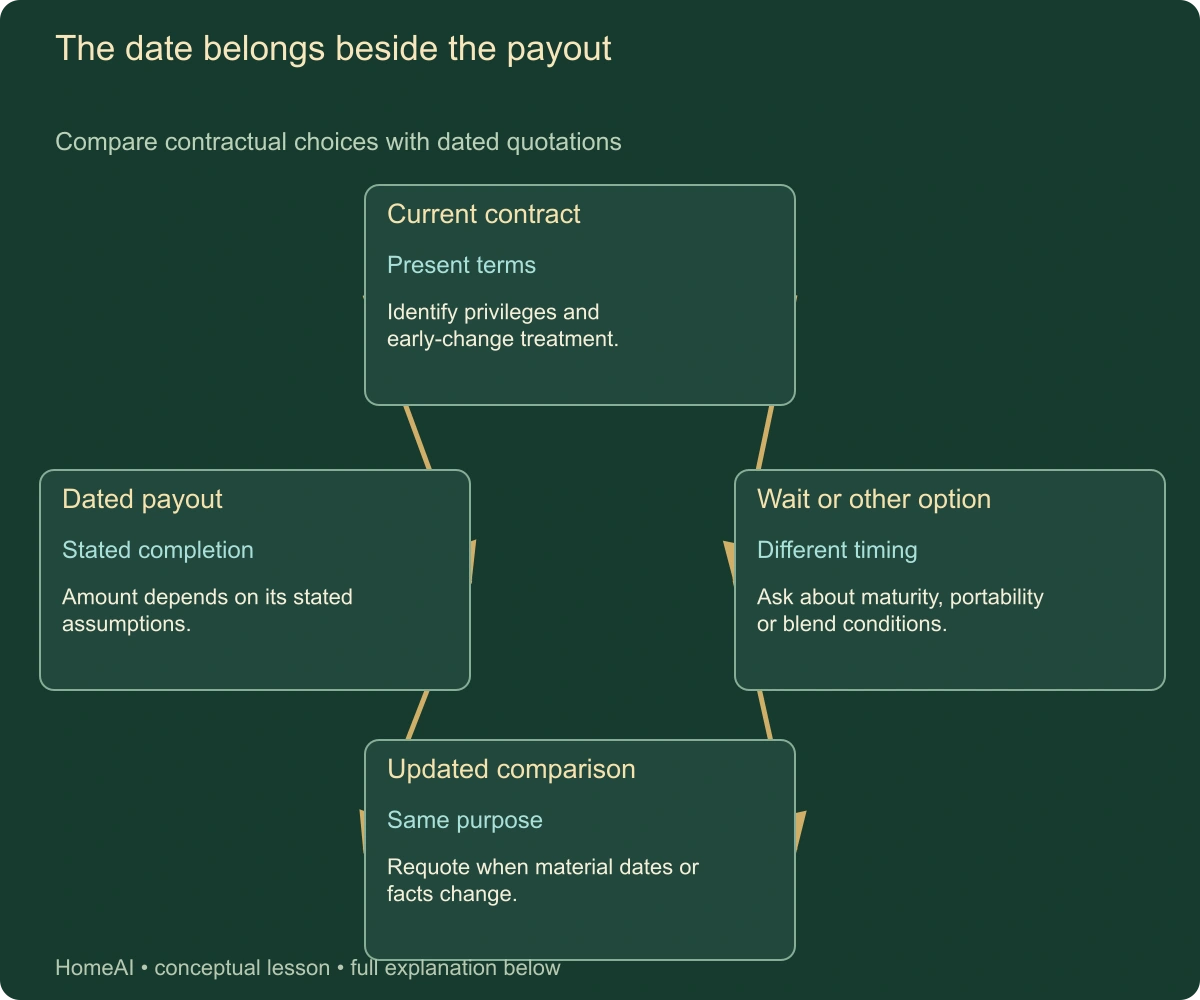
Two possible paths leave the current contract: the dated early-change quotation and a feasible alternative with its own conditions. Reconcile their dates before comparing cost.
Numbers identify the parts explained below.
- Current contract
Present terms. Identify privileges and early-change treatment.
- Dated payout
Stated completion. Amount depends on its stated assumptions.
- Wait or other option
Different timing. Ask about maturity, portability or blend conditions.
What does this illustration leave out?
No universal IRD formula, waiver, savings or portability approval. This illustration explains an idea. It is not an installation guide.
Are every charge and alternative tied to the same intended purpose and date?
Explore this with HomeAI ↗Opens an editable question. Nothing is sent until you choose to send it.Read the complete figure
The date belongs beside the payout
Compare contractual choices with dated quotations
- Current contract
- Present terms. Identify privileges and early-change treatment.
- Dated payout
- Stated completion. Amount depends on its stated assumptions.
- Wait or other option
- Different timing. Ask about maturity, portability or blend conditions.
- Updated comparison
- Same purpose. Requote when material dates or facts change.
- Current contract → Dated payout: Request actual amount.
- Current contract → Wait or other option: Compare feasible route.
- Dated payout → Updated comparison: Known charges.
- Wait or other option → Updated comparison: Different conditions.
Two possible paths leave the current contract: the dated early-change quotation and a feasible alternative with its own conditions. Reconcile their dates before comparing cost.
What remains unknown: No universal IRD formula, waiver, savings or portability approval.
A useful question: Are every charge and alternative tied to the same intended purpose and date?
Conceptual teaching diagram. Complete labels and their meanings follow in static text.
Could waiting, porting or blending meet the same need?
Waiting until term end can remove the early-contract-change element from one comparison, but it may not meet the household’s timing needs. Define what waiting means: continuing the current payments until maturity and arranging the next loan then. Do not assume the future rate, future approval or property value. Ask what can be offered now and which decisions must remain open.
Portability concerns moving an existing mortgage arrangement to another property with lender approval. It is different from changing lenders. Ask about the actual property, timing window, borrowing difference and conditions. A planned move to a less expensive home or a need for extra borrowing may change the result. A portable label alone does not prove a charge-free move or release from every obligation.
A blend-and-extend proposal combines rate and term elements under the lender’s stated method. FCAC describes it as a possible early-renewal option with potential administration costs. Read the actual proposal rather than copying an illustrative blended-rate formula. Compare the new contract end date, payment, balance and future exit conditions. Avoid treating the absence of one named penalty as the absence of all cost.
Other borrowing products can meet different needs but should not be treated as interchangeable. A separate secured loan or line of credit has its own rate, repayment and security conditions. Ask the adviser to explain why the proposed product fits the intended use and what alternatives were compared. The illustration here does not recommend adding debt merely to avoid examining an inconvenient existing contract.
How do you compare offers over the same period?
Choose a common observation horizon that answers the household’s decision. It might be the time to the current maturity date or a planned sale, rather than the end of whichever proposal has the longest term. Ask for balances and payments at that same date under disclosed assumptions. Comparing one proposal over two years with another over five years mixes different periods and can hide debt left behind.
Keep cash flow and economic comparison separate. Payments consume cash, but part of a mortgage payment may reduce principal. Interest and non-reimbursed fees are costs within the stated boundary; principal repayment changes what remains owing. A proposal that saves monthly cash while leaving more debt needs that difference shown. Neither payment alone nor a rate alone describes the complete comparison.
For a bounded illustration with the same opening debt, subtract the debt reduction from the debt-payment total, then add the included non-financed charges. State which items are excluded and avoid double counting. If fees are financed, the opening debt and later balance must reflect them consistently. Actual compounding, payment timing, changing rates and lender methods require proper schedules from the relevant professional.
Future-variable-rate scenarios should say exactly what is assumed. They are sensitivity exercises, not forecasts. Ask how the ranking changes if an assumption changes, whether the household can carry the withdrawals and what happens if plans change earlier. A comparison can remain inconclusive because the available proposals differ in timing, approval or flexibility. That is a useful finding, not a reason to hide the missing information.
Choose the comparison date for a reason. If a sale is likely in two years, comparing only the first monthly payment misses the debt and possible exit charge at that sale. If the two proposed terms end on different dates, do not silently treat the first term end as the finish for both. Ask the lender to show a common date and explain assumptions beyond any guaranteed period. An unknown future renewal rate belongs in a sensitivity question, not a disguised prediction.
Keep financed fees visible in both the opening balance and the cash record. A charge rolled into the new loan does not become free because no separate cheque is written. It can affect interest and the balance remaining at the comparison date. Conversely, do not add the same financed charge again as a separately paid expense. A professional comparison should reconcile the complete advance, actual out-of-pocket amounts and the remaining debt without double counting.
Test the comparison against a changed household plan. Ask for a second illustration if the expected lump sum arrives later, the sale moves forward or the household cannot maintain an assumed extra payment. These are planning cases, not instructions to choose a product. An option whose apparent advantage depends on every voluntary prepayment occurring deserves a different description from one based only on the required payments.
Compare the same money boundary and period
- Payment cashWhat leaves the household during the chosen interval.
- Principal reductionWhat reduces debt within those payments.
- Included costsInterest and properly included charges.
- End balanceDebt still requiring repayment at the common horizon.
Conceptual arithmetic framework; actual lender schedules and financed charges must be reconciled.
Further reading: .
Where do registration, related debts and cash timing fit?
A registered charge is the lender’s security against the property. Paying the mortgage balance does not automatically complete the release of that registered interest. FCAC describes discharge as a process involving the lender and the provincial or territorial registry. Use the appropriate legal professional to reconcile the transaction requirements, completion evidence and any related secured products.
Collateral security can cover more than the mortgage account discussed in the offer. Ask whether a line of credit or another loan is secured by the same charge and what must be repaid, transferred or closed for the proposed change. The registered amount is not the actual balance owing. A current account statement and the registration answer different questions and belong together in the review.
List when money must be available as well as its eventual total. Appraisal or professional costs may arise before completion, while reimbursements may arrive later. Ask about the actual payment method, funding conditions and delay consequences. Do not cancel an existing payment arrangement or rely on assumed new funding before receiving the relevant completion advice.
Coordinate a sale or purchase with its own closing-cash statement. Debt payout, purchase proceeds, deposit credit and new borrowing must be reconciled for the actual dates. The closing-cash guide explains those money boundaries in greater depth. Here the key question is whether the mortgage change can be completed as proposed while the household retains funds for ownership costs and identified property work.
Paying debt and releasing security are different
The debt and registered-security lanes are connected but have different completion records. Related secured borrowing can matter to the release enquiry.
Numbers identify the parts explained below.
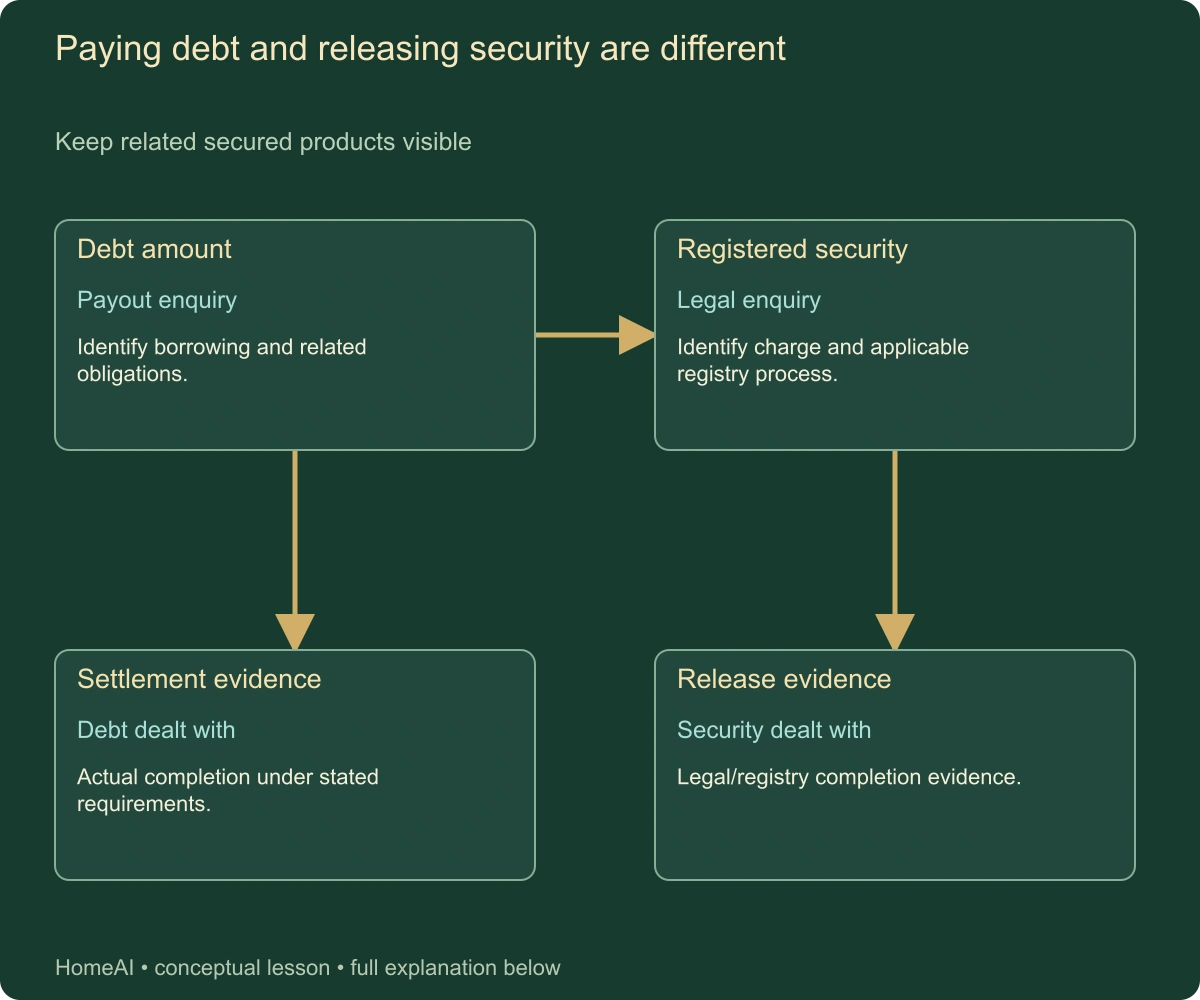
- Debt amount
Payout enquiry. Identify borrowing and related obligations.
- Registered security
Legal enquiry. Identify charge and applicable registry process.
- Settlement evidence
Debt dealt with. Actual completion under stated requirements.
What does this illustration leave out?
No actual discharge, regional filing procedure or universal fee. This illustration explains an idea. It is not an installation guide.
Which evidence confirms each actual completion task?
Explore this with HomeAI ↗Opens an editable question. Nothing is sent until you choose to send it.Read the complete figure
Paying debt and releasing security are different
Keep related secured products visible
- Debt amount
- Payout enquiry. Identify borrowing and related obligations.
- Registered security
- Legal enquiry. Identify charge and applicable registry process.
- Settlement evidence
- Debt dealt with. Actual completion under stated requirements.
- Release evidence
- Security dealt with. Legal/registry completion evidence.
- Debt amount → Settlement evidence: Settlement process.
- Registered security → Release evidence: Release process.
- Debt amount → Registered security: Related, different jobs.
The debt and registered-security lanes are connected but have different completion records. Related secured borrowing can matter to the release enquiry.
What remains unknown: No actual discharge, regional filing procedure or universal fee.
A useful question: Which evidence confirms each actual completion task?
Conceptual teaching diagram. Complete labels and their meanings follow in static text.
What does a fictional comparison reveal?
Fictional Noor and Alex compare two invented proposals for the same opening debt and a twenty-four-month horizon. Their purpose is to reduce financing cost while keeping a possible move visible. The amounts are made up in Canadian dollars and are not rates, quotes or recommended thresholds. Both proposals are assumed approved solely for this classroom calculation; real approval remains a separate gate.
Proposal A has CAD48,000 of debt payments over the period, CAD1,000 of separately paid included fees and CAD12,000 of principal reduction. Its bounded interest-and-fee amount is CAD48,000 minus CAD12,000 plus CAD1,000, or CAD37,000. The calculation excludes tax collections, optional insurance, property expenses and any cost beyond the stated horizon.
Proposal B has CAD45,000 of debt payments, CAD5,000 of separately paid included fees and CAD10,000 of principal reduction. Its comparable amount is CAD45,000 minus CAD10,000 plus CAD5,000, or CAD40,000. B uses CAD3,000 less payment cash but leaves CAD2,000 more debt and requires CAD4,000 more separately paid fees. Within these invented assumptions it is CAD3,000 higher on the bounded cost measure.
That does not establish a winner for a real household. Noor and Alex still need the cash schedule, actual approval, future exit conditions and properly prepared balances. They ask what happens if the move occurs at month twelve and which charges change with the date. The comparison teaches why a smaller withdrawal can coexist with a higher bounded cost; it does not forecast rates, guarantee savings or replace lender calculations.
Their invented table deliberately leaves future exit charges outside the subtotal because none has been quoted. It would be misleading to label the subtotal the full cost of selling at month twenty-four. Noor asks each lender for the relevant early-exit treatment and dates the request. Alex asks whether the balance illustration assumes voluntary prepayments. They retain unanswered items next to the numbers, rather than filling those cells with zero.
They also separate an ability to pay from an expected cost. Even if A has the lower bounded cost in this made-up example, its larger scheduled withdrawals might not fit their actual household. B might require upfront cash that they do not have. Their next decision is whether both proposals are feasible on the same factual budget, not whether a spreadsheet can be made to show an attractive winner.
Less payment cash can leave a higher bounded cost
B uses3,000less payment cash, reduces debt by2,000less and adds4,000more separate fees. The displayed bounded subtotal is3,000higher; uncertain future exit charges remain outside it.
Numbers identify the parts explained below.
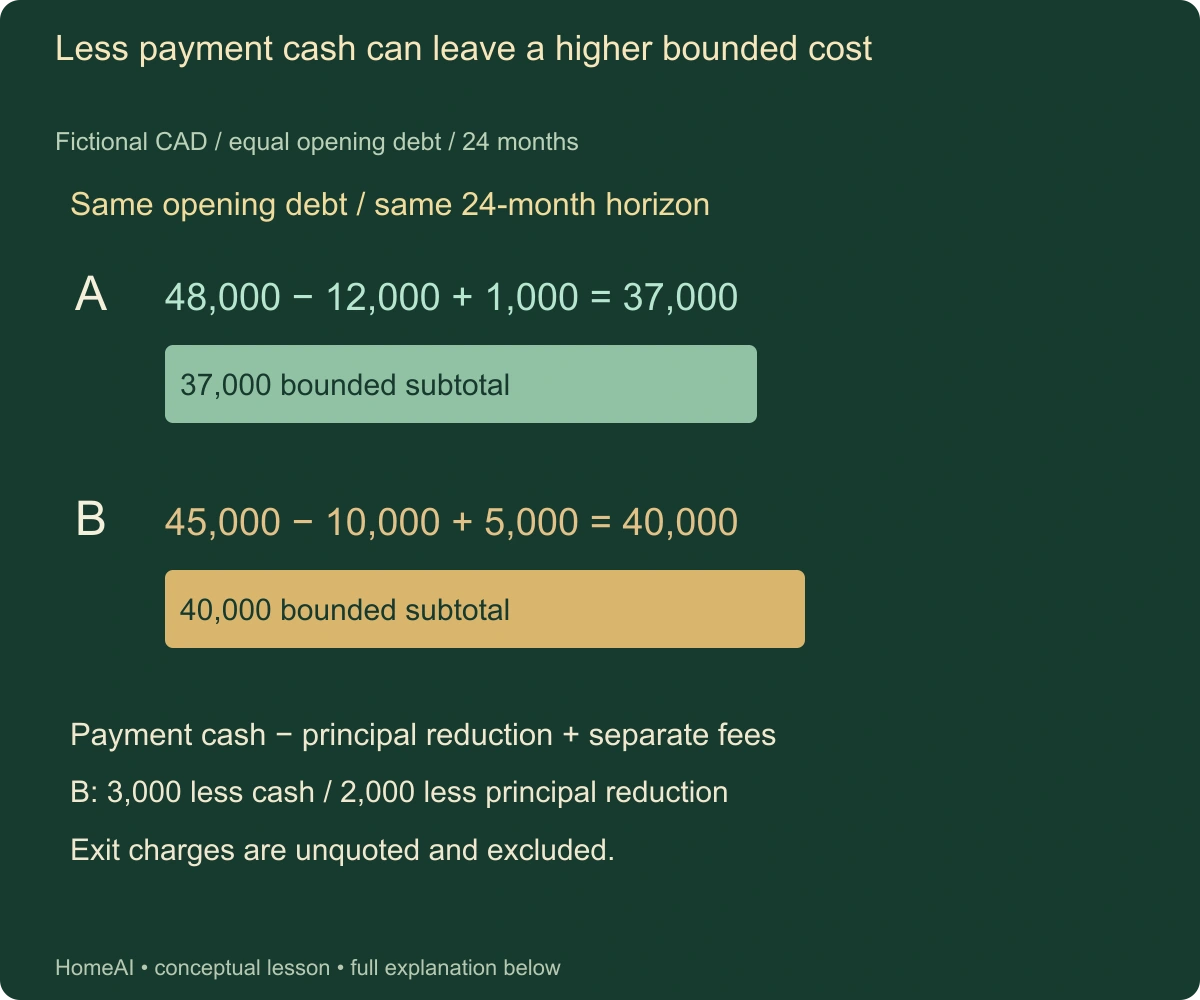
- A: payment cash
48,000. Principal reduction12,000; separate fees1,000.
- A: bounded subtotal
37,000. 48,000−12,000+1,000.
- B: payment cash
45,000. Principal reduction10,000; separate fees5,000.
What does this illustration leave out?
No actual lender schedule, approval, future exit amount or complete real-household winner. This illustration explains an idea. It is not an installation guide.
What assumptions and unquoted exit charges remain outside the real comparison?
Explore this with HomeAI ↗Opens an editable question. Nothing is sent until you choose to send it.Read the complete figure
Less payment cash can leave a higher bounded cost
Fictional CAD / equal opening debt / 24 months
- A: payment cash
- 48,000. Principal reduction12,000; separate fees1,000.
- A: bounded subtotal
- 37,000. 48,000−12,000+1,000.
- B: payment cash
- 45,000. Principal reduction10,000; separate fees5,000.
- B: bounded subtotal
- 40,000. 45,000−10,000+5,000.
B uses3,000less payment cash, reduces debt by2,000less and adds4,000more separate fees. The displayed bounded subtotal is3,000higher; uncertain future exit charges remain outside it.
What remains unknown: No actual lender schedule, approval, future exit amount or complete real-household winner.
A useful question: What assumptions and unquoted exit charges remain outside the real comparison?
Conceptual teaching diagram. Complete labels and their meanings follow in static text.
Which answers should you obtain before committing?
Ask the lending professional to identify the proposal, opening debt, payment behaviour, remaining balance at the agreed horizon and all relevant charges. Ask what is provisional, what approval conditions remain and when a quotation expires. Keep a dated copy of the actual terms rather than relying on a screenshot of a headline rate. A clear answer links each figure to its period and assumptions.
Ask the legal professional about the existing and proposed security, related obligations and transaction steps. Their review should identify the jurisdiction and the actual registration documents. Ask the insurer or lender about mortgage-insurance records where relevant, and keep that separate from home-property insurance. Similar words can describe different products and responsibilities.
If the payment is becoming unaffordable, contact the institution promptly to discuss your circumstances and available options. A comparison article cannot determine the relief or new borrowing available to you. Avoid paying an unsolicited intermediary on a promise of guaranteed refinancing. Use known contact channels for the institution and the professionals already engaged, especially when instructions involve transferring money.
Preserve the final decision and completion record: the signed contract, agreed illustrations, payment instructions verified through trusted channels, payout and legal completion evidence, and the next review date. Explain any remaining property work or household-budget assumptions beside it. A completed switch is evidence of that transaction, not proof that every future move, renewal or financial difficulty will have the same outcome.
Before a planned move, ask which property must satisfy a portability application and what happens if the sale and purchase do not complete together. Do not schedule the household around a generic statement that the mortgage is portable. The existing contract and lender decision need to address the actual new property, amount, dates and any additional borrowing. A bridge or other temporary financing proposal needs its own approval and written costs.
After completion, compare the first payment notice and opening statement with the signed arrangement. Check the loan amount, payment frequency, next due date and any separately collected items. Ask the institution to explain differences while the completion records are available. Keep proof of how the former borrowing and related security were dealt with through the legal professional. Stopping an old payment instruction yourself is not a substitute for confirming the actual completion steps.
A useful decision note can be short: the household purpose, proposals compared, common horizon, dated source of each amount, conditions still open and why the chosen arrangement fits the household. Keep the actual quotation with the note. This allows a later renewal or move to start from identified facts rather than a recollection that the last offer had the lowest rate.
Keep learning about the connected parts
- Understanding mortgage structure: payments, balance and flexibility
- Cash required for closing: deposit, advance, adjustments and deadlines
- Your first year in a home: turn findings and bills into a budget
- Before you make an offer: what to check, who to ask
- Renovation records: what was proposed, approved and built?
- Selling one home and buying the next: money, dates and dependencies
Canadian context and authorities · Visual atlas · Learning labs
Practice the distinction.
A lower withdrawal can still leave a higher bounded cost
Fictional Noor and Alex compare invented proposals over 24 months, using equal opening debt and separately paid fees.
Reported observations
- A: CAD 48,000 payments − CAD 12,000 principal reduction + CAD 1,000 separate fees = CAD 37,000.
- B: CAD 45,000 payments − CAD 10,000 principal reduction + CAD 5,000 separate fees = CAD 40,000.
- B uses CAD 3,000 less payment cash while leaving CAD 2,000 more debt and requiring CAD 4,000 more separate fees.
A useful next question
Obtain actual schedules, approvals, cash timing and exit conditions; these invented figures forecast nothing.
Know what the words mean.
- Mortgage renewal
- The next contract arrangement for debt remaining at the end of a term.
- Lender switch
- Moving borrowing to another lender, subject to its approval and the transaction’s security requirements.
- Refinancing
- A changed borrowing arrangement that can alter debt, repayment or funds available.
- Mortgage payout
- A dated statement of the amounts required to settle the identified borrowing under the stated conditions.
- Interest rate differential
- A lender-specific comparison of interest calculations used in some prepayment-charge methods.
- Mortgage discharge
- The process for releasing registered mortgage security after the relevant requirements are met.
- Comparison horizon
- The same stated end date used to compare payments, charges and remaining balances.
Questions to bring
to the conversation.
- Which current debt and completion date does each quotation use?
- What is financed, separately paid, reimbursed or conditional?
- Which balance and exit conditions remain at the same comparison date?
- What approval, legal-security and funding conditions are still open?
Separate a showing observation, an existing record and a new professional assessment. Unknown means a question remains; it does not automatically mean a defect.
Use the evidence planner ↗Go to the source.
Original HomeAI explanation informed by these public references. Sources support the underlying guidance; they have not reviewed or endorsed HomeAI. Diagrams are conceptual, and calculator outputs depend on your inputs.
Current FCAC full substantive pages were read October 13, 2026. Their printed page dates and federal institutional scope remain explicit. No personal qualification, universal penalty formula, actual quote, tax treatment or rate forecast is supplied. Numerical scenarios are fictional CAD and bounded to their stated period.
Publication & source review
First published .
Sources reviewed .
Have a question about your home?
Start with the symptom, timing and what you have observed.
Ask HomeAI