Jump to a question in this guide
- What does “fully restored” need to mean for this transaction?
- Reconstruct the event without turning recollection into a finding
- Separate source control, remediation and reinstatement
- Find the actual boundary of the restoration
- Understand drying evidence without inventing a pass mark
- Keep health questions with the right professionals
- Read sampling and post-remediation reports for their actual job
- Reinstatement can change more than the appearance
- Separate the insurance settlement from the completed property
- Price remaining work and uncertainty separately
- Resolve transaction responsibilities before relying on a promise
- Check the present home and the permitted use of old reports
- Fictional case: Rowan compares a finished room with the restoration scope
- Handover the evidence and the remaining questions
- For water or moisture restoration, trace the event and affected locations through source correction, remediation, drying and reinstatement.
- Read each finding for its actual locations, method, date and exclusions; new finishes and paid invoices do not establish the complete result.
- Connect the present condition enquiry, authorized use of reports, remaining work and the buyer’s actual insurance response before relying on a restoration claim.
The jobs can overlap, but completion of one does not establish the others.
About this illustration
No actual source correction, cleanup, drying, health or safety result. This is a conceptual teaching model, not an assessment of your home.
7 picture lessons appear beside the questions in this guide. Use them to understand the explanation, then consider what it means for your home.
What does “fully restored” need to mean for this transaction?
A restored home may offer good accommodation after substantial work, but the phrase fully restored is too broad to carry a purchase decision. The buyer needs to understand what happened, what areas were affected, what work followed and what the evidence says about the home now. A seller needs a clear account that does not stretch a contractor's document beyond its actual scope.
Start with the event and the property. Identify the address, affected building or unit, approximate dates and type of reported damage. Floodwater, a plumbing escape and a long-running envelope leak can create different investigation questions. This guide develops the water-and-moisture enquiry. Fire or smoke restoration needs its own relevant specialist scope and evidence; the moisture sources used here do not supply that technical assessment. This guide follows the transaction after major work; it does not provide emergency cleanup instructions, diagnose contamination or authorize entry into an unsafe building.
The earlier flood-recovery, mould, renovation-permit and insurance guides retain their own jobs. Here the focus is the connection between history, authorized scope, performed work, technical findings, present insurance and the obligations that may pass with a sale. A recently finished room is part of that enquiry rather than its conclusion.
Health Canada's January 2023 moisture-and-mould guide and its flood-cleanup page provide the bounded health context. The flood page carries a 2014 publication label and November 26, 2024 page details. The mould body says January 2023 despite a legacy 2020 page-details date; both are retained in the source record. IBC's current served flood-and-insurance body supplies policy-specific questions. None establishes this home's health, structural condition or coverage.
The useful starting statement is specific: identified damage was addressed by identified work, with these inspections and these remaining limits. That statement gives advisers something to test. It also leaves room for a properly documented restoration to be understood on its merits, without assuming every damaged home is unacceptable or every new finish resolves its history.
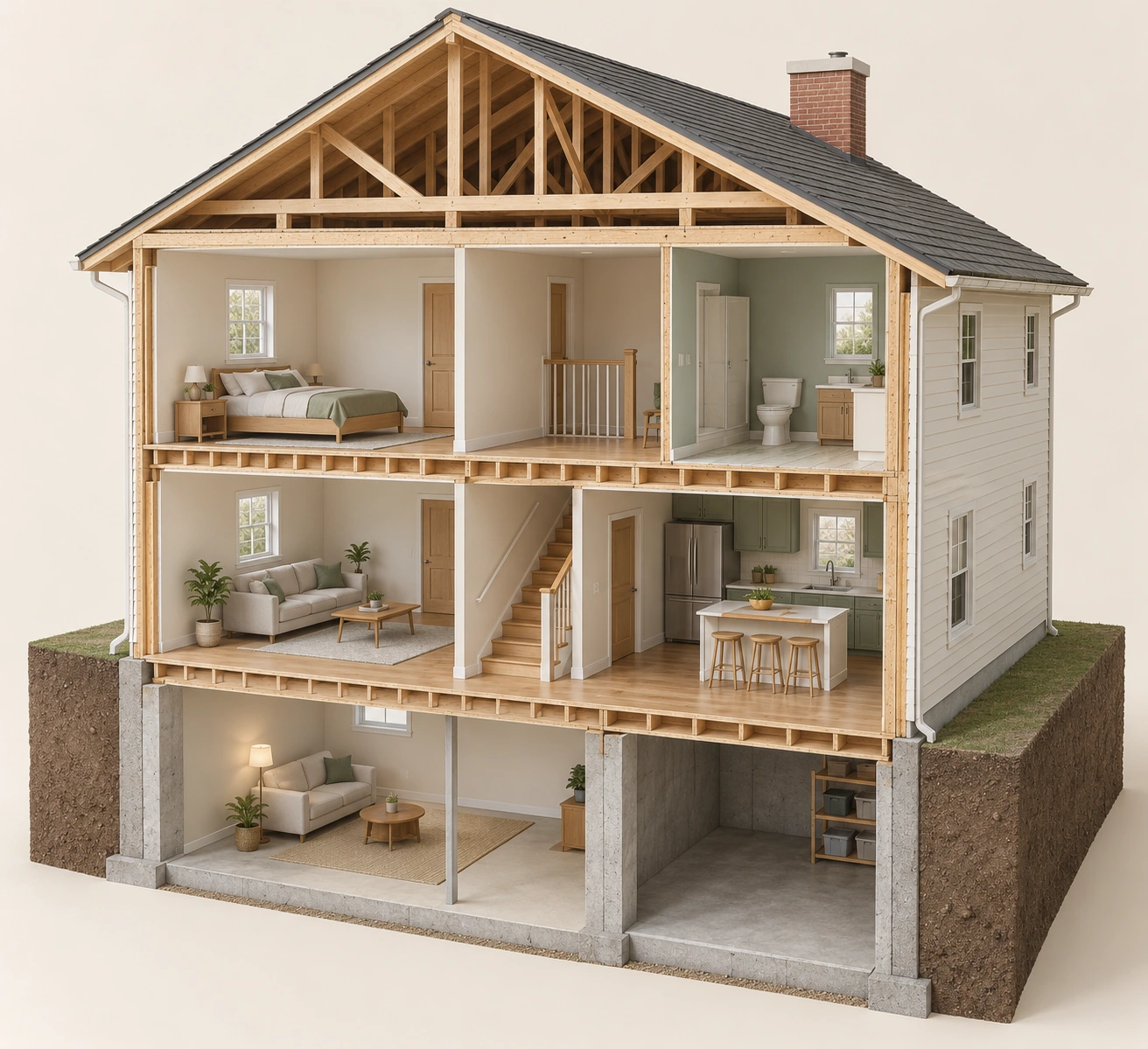
Which locations and stages did the actual restoration cover
Architectural whole-home cutaway with finished lower room beside a plain storage room; no damage history, drying result or completion certification.
Numbers identify the parts explained below.
- Visible context
Architectural whole-home cutaway with finished lower room beside a plain storage room; no damage history, drying result or completion certification.
- Limit
Conceptual generated context. No actual property, installed design, topology, measured performance, approval, ownership or responsibility established.
What does this illustration leave out?
Conceptual generated context. No actual property, installed design, topology, measured performance, approval, ownership or responsibility established. This illustration explains an idea. It is not an installation guide.
Which locations and stages did the actual restoration cover?
Explore this with HomeAI ↗Opens an editable question. Nothing is sent until you choose to send it.Which locations and stages did the actual restoration cover
Architectural whole-home cutaway with finished lower room beside a plain storage room; no damage history, drying result or completion certification.
What remains unknown: Conceptual generated context. No actual property, installed design, topology, measured performance, approval, ownership or responsibility established.
A useful question: Which locations and stages did the actual restoration cover?
Reconstruct the event without turning recollection into a finding
Build a chronology from the earliest available evidence: the reported event, discovery, emergency response, investigation, remediation, reinstatement and later observations. Keep the date of a record separate from the date of the event it describes. An invoice issued months later can relate to earlier work, while a later photograph may show only the reinstated surface.
Attribute statements to their author. An owner's recollection of a short leak, an adjuster's loss description and a technical report on wet materials answer different questions. If they disagree, record the disagreement for the relevant professional instead of selecting the most reassuring account. A missing early photograph is a limitation, not proof that damage was either minor or extensive.
Locate each affected area on a simple room-and-level plan. Include nearby cavities, services and adjacent spaces where the actual records identify involvement. Do not expand the damage boundary merely because a room adjoins another room, and do not shrink it because only one room received new flooring. The investigation needs to support the boundary.
Health Canada identifies several possible moisture sources, including plumbing, exterior infiltration, condensation and flooding. That is why the transaction should distinguish an observed wet area from a determined cause. A drying invoice can document a response to moisture without establishing why the moisture arrived or whether the source was corrected.
Ask the seller or authorized record holder for the unedited relevant reports and attachments. Private claim information may require permission and appropriate redaction. The buyer does not acquire a right to someone's complete insurance file merely by asking; the practical question is whether enough authorized evidence can be provided to evaluate the property and obtain advice.
Separate source control, remediation and reinstatement
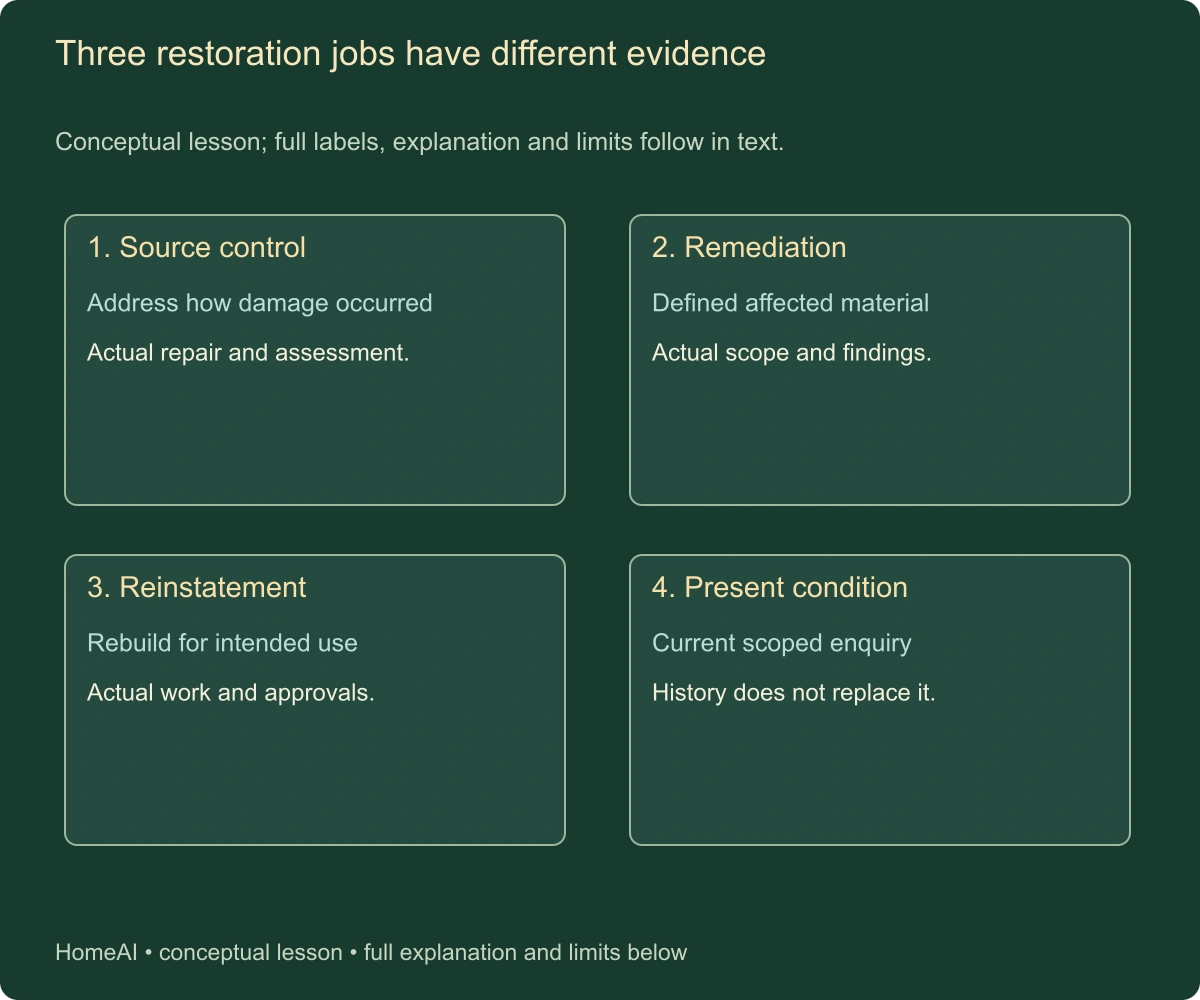
Major restoration often contains three different jobs. Source control addresses how damage occurred or could recur. Remediation addresses affected material and contamination within a defined scope. Reinstatement rebuilds the finishes, assemblies and services needed for the intended use. These jobs can overlap in time, but one does not automatically establish the others.
A repaired pipe may address the reported leak while leaving drying and material questions. Removal of affected wallboard may address part of remediation while leaving the exterior leak unresolved. New paint, trim and flooring may complete reinstatement without explaining either earlier job. Request the relevant scope and completion record for each function.
Health Canada states that mould can return unless its moisture cause is identified and solved. It also explains that painting a mouldy surface does not resolve the underlying growth. Those principles support asking what was removed or cleaned and what changed at the source; they do not permit a buyer to decide from a photograph whether a particular concealed assembly contains mould.
Use a work table with location, problem addressed, authorized task, provider, performed date, completion evidence and remaining limitation. Keep provisional scope changes visible. If demolition revealed more affected material, the final account should show how that discovery changed the work rather than relying solely on the original estimate.
The transaction should not reward a neat sequence on paper if the actual work differed. Equally, an out-of-order document date does not itself establish poor work. A competent professional can reconcile the technical sequence, while legal and insurance advisers address the separate contract and claim consequences.
Three restoration jobs have different evidence
The jobs can overlap, but completion of one does not establish the others.
Numbers identify the parts explained below.
- Source control
Address how damage occurred. Actual repair and assessment.
- Remediation
Defined affected material. Actual scope and findings.
- Reinstatement
Rebuild for intended use. Actual work and approvals.
What does this illustration leave out?
No actual source correction, cleanup, drying, health or safety result. This illustration explains an idea. It is not an installation guide.
Which actual documents and qualified advice resolve the distinction?
Explore this with HomeAI ↗Opens an editable question. Nothing is sent until you choose to send it.What can a new finish establish, and what remains concealed
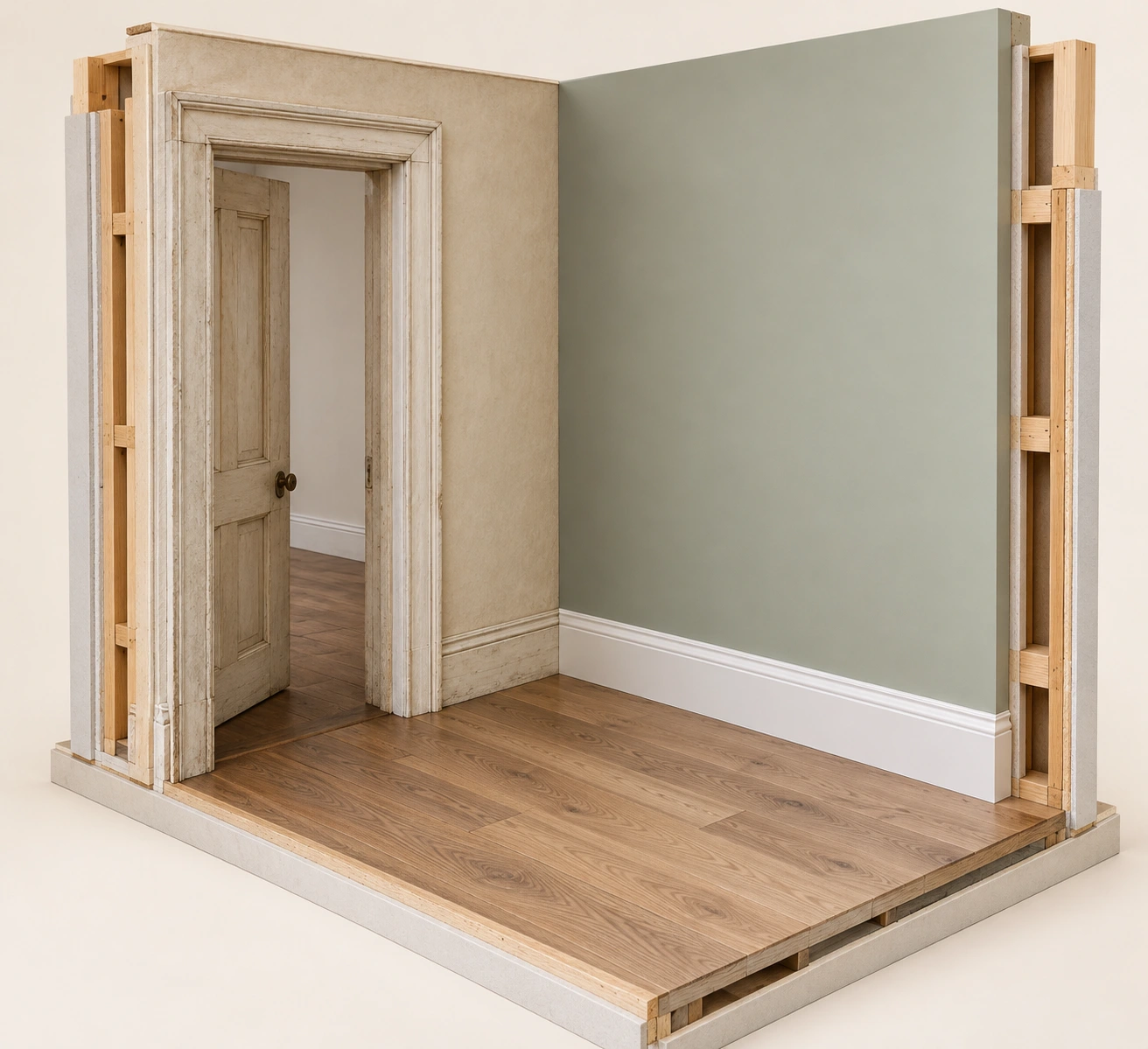
New painted wall/baseboard/floor beside older doorway; generic cutaway margins do not prove hidden drying or remediation.
Numbers identify the parts explained below.
- Visible context
New painted wall/baseboard/floor beside older doorway; generic cutaway margins do not prove hidden drying or remediation.
- Limit
Conceptual generated context. No actual property, installed design, topology, measured performance, approval, ownership or responsibility established.
What does this illustration leave out?
Conceptual generated context. No actual property, installed design, topology, measured performance, approval, ownership or responsibility established. This illustration explains an idea. It is not an installation guide.
What can a new finish establish, and what remains concealed?
Explore this with HomeAI ↗Opens an editable question. Nothing is sent until you choose to send it.Three restoration jobs have different evidence
Conceptual lesson; full labels, explanation and limits follow in text.
- Source control
- Address how damage occurred. Actual repair and assessment.
- Remediation
- Defined affected material. Actual scope and findings.
- Reinstatement
- Rebuild for intended use. Actual work and approvals.
- Present condition
- Current scoped enquiry. History does not replace it.
The jobs can overlap, but completion of one does not establish the others.
What remains unknown: No actual source correction, cleanup, drying, health or safety result.
A useful question: Which actual documents and qualified advice resolve the distinction?
What can a new finish establish, and what remains concealed
New painted wall/baseboard/floor beside older doorway; generic cutaway margins do not prove hidden drying or remediation.
What remains unknown: Conceptual generated context. No actual property, installed design, topology, measured performance, approval, ownership or responsibility established.
A useful question: What can a new finish establish, and what remains concealed?
Find the actual boundary of the restoration
An estimate describes proposed work. An invoice describes charges. A completion statement describes whatever its author was engaged to confirm. None should silently become a whole-building certification. Read the property, rooms, components, exclusions and inaccessible areas in each record before using the word complete.
Compare the initial scope with revisions, change orders and the final performed-work description. Was a ceiling opened only below the reported leak, or were adjacent cavities assessed? Was insulation replaced, retained or outside the scope? These are questions for the actual providers, not assumptions that every project needs the same demolition or replacement.
Pay particular attention to interfaces. A replaced wall finish meets an existing floor, window, service penetration or adjoining room. The practical issue is whether the work accounted for the relevant connection and left any identified investigation outstanding. Generic diagrams can explain why boundaries matter but cannot show what this house contains behind its finish.
Where scope remains unclear, ask an appropriate independent professional what further evidence or inspection could reasonably resolve it. The answer may be a review of photographs and logs, a site visit or another investigation under authorized conditions. It is not automatically destructive opening, and a buyer should not cut into assemblies or disturb suspect material during a viewing.
An honest boundary can make a report more useful. A statement confined to the basement's identified rooms may be reliable within that scope. The problem arises when marketing or conversation expands it to the entire home, every moisture source or future freedom from damage. Keep the original qualification beside the finding.
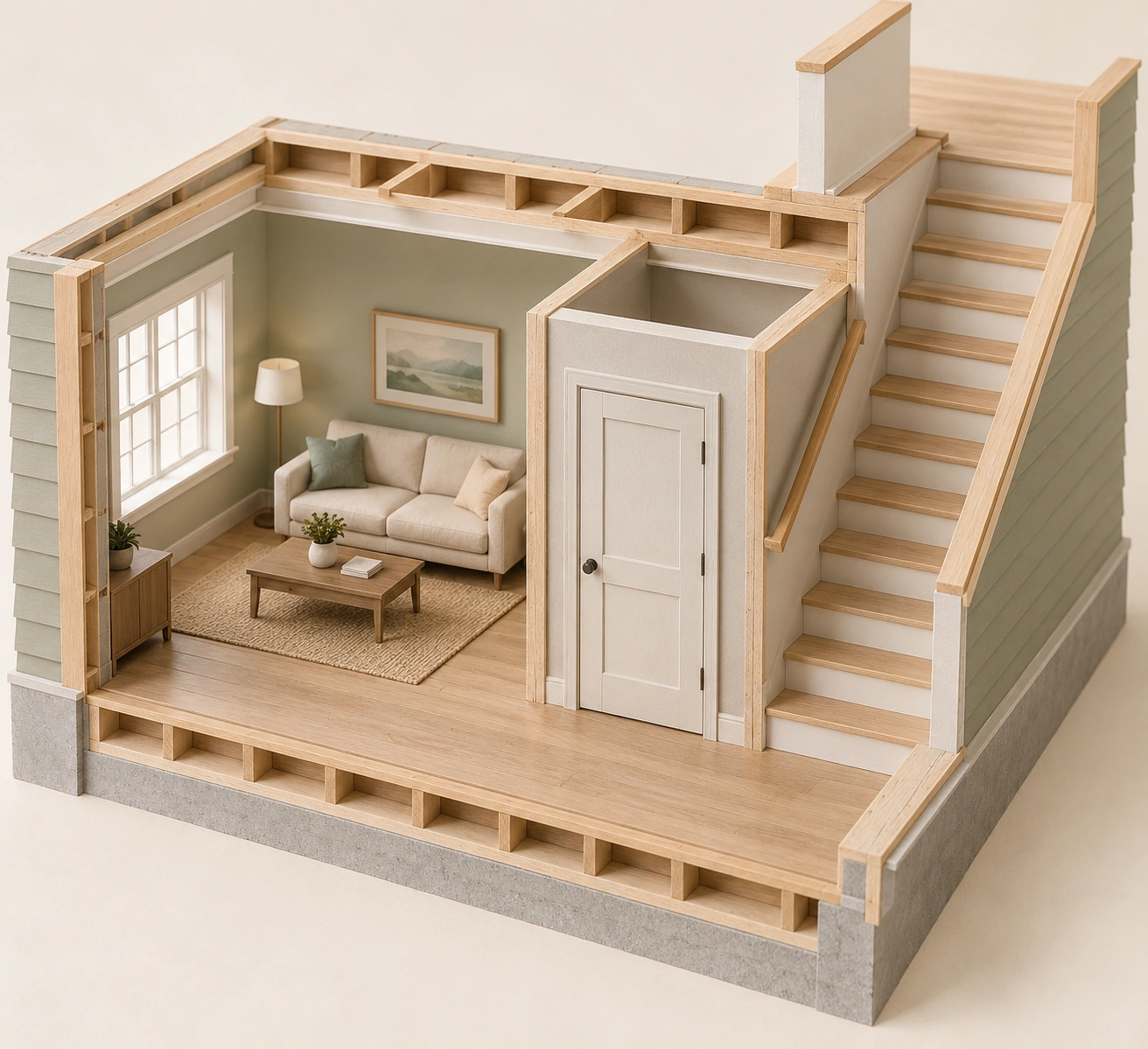
How does the actual room repair scope relate to associated equipment
Finished room, closed closet and stair; associated equipment and its restoration scope remain unseen.
Numbers identify the parts explained below.
- Visible context
Finished room, closed closet and stair; associated equipment and its restoration scope remain unseen.
- Limit
Conceptual generated context. No actual property, installed design, topology, measured performance, approval, ownership or responsibility established.
What does this illustration leave out?
Conceptual generated context. No actual property, installed design, topology, measured performance, approval, ownership or responsibility established. This illustration explains an idea. It is not an installation guide.
How does the actual room repair scope relate to associated equipment?
Explore this with HomeAI ↗Opens an editable question. Nothing is sent until you choose to send it.How does the actual room repair scope relate to associated equipment
Finished room, closed closet and stair; associated equipment and its restoration scope remain unseen.
What remains unknown: Conceptual generated context. No actual property, installed design, topology, measured performance, approval, ownership or responsibility established.
A useful question: How does the actual room repair scope relate to associated equipment?
Understand drying evidence without inventing a pass mark
Drying records can help connect wet conditions, equipment use, measurement locations and the decision to proceed with reinstatement. Ask what was measured, with which method, on what dates and at which locations. A number without its material, method and interpretation is difficult to use, even when it appears in a professional-looking table.
Distinguish an equipment-rental invoice from a drying assessment. The presence of fans or dehumidifiers shows a response was attempted; it does not by itself establish the condition of every cavity. Likewise, a final reading from one accessible surface does not automatically describe concealed insulation or a different room. The actual professional should explain the applicable scope and limitations.
Health Canada's flood guidance emphasizes prompt removal of water and damaged material and effective drying. Its general timing discussion is a reason to seek the actual response history, not a retrospective stopwatch that proves a house is safe or unsalvageable. This guide does not prescribe a universal moisture threshold, drying duration or instrument procedure.
Ask how the provider decided that the next stage could begin and whether any wet or inaccessible areas remained. If there were repeated visits or equipment changes, retain their chronology. A period of acceptable accessible readings may be useful evidence, but a later leak or new symptom still deserves its own assessment.
For the transaction, summarize the result in plain language that the provider supports: identified materials and locations were assessed on stated dates under stated conditions. Avoid converting that into a promise of permanent dryness. The present enquiry must also consider the moisture source, reinstatement and current observations.
Keep health questions with the right professionals
Health Canada associates dampness and mould exposure with respiratory and other health concerns and identifies people who may be more susceptible. It does not propose a health-based indoor mould exposure limit. A buyer should therefore avoid treating an arbitrary count, an absence of odour or a contractor's reassurance as a personal medical clearance.
If health symptoms or vulnerability affect the household's decision, discuss them with an appropriate healthcare professional. A building professional can investigate the environment and document conditions; that role differs from assessing an individual's symptoms or determining whether a particular person should occupy the home. Both questions may matter without being interchangeable.
The January 2023 guide calls for professional involvement in circumstances including recurrent or suspected hidden mould and contaminated floodwater. For a transaction after major restoration, ask what relevant concern was assessed, who performed that assessment and how the findings affected scope. Do not infer contamination solely from the event label or infer its absence from attractive finishes.
Keep safe-access questions separate from the purchase timetable. If there is an active concern about electrical, structural or contamination hazards, obtain the appropriate authority or qualified advice before entry or disturbance. A condition-removal date in a purchase agreement cannot make an unsafe inspection appropriate.
The buyer's goal is a supported decision within the household's actual needs. An unresolved environmental question may justify more investigation, a different timing arrangement or choosing another property. This guide cannot establish the medical suitability of a home, and generic illustrations provide no health evidence.
Read sampling and post-remediation reports for their actual job
Health Canada generally does not recommend air testing for mould because it does not predict health effects and often gives little information about the cause. The guide allows that a qualified professional may recommend particular testing in some unresolved circumstances. The lesson is to ask what question a proposed test answers rather than ordering a generic certificate for reassurance.
For an existing report, identify the author, engagement, locations, methods, date, observed conditions and interpretation. Ask whether the work evaluated removal of identified mould, investigated an unexplained concern or served another purpose. Those assignments can lead to different conclusions and cannot be reduced to the single label clearance.
Health Canada discusses an independent post-remediation inspection for major projects and the anticipated documentation and quality-control process. Independence and scope are separate considerations. A separate consultant may provide useful oversight, but the report still needs to say what was examined and what was inaccessible or excluded.
Keep laboratory results with the interpreting professional's report. A table detached from its sampling context is easy to misread. A result at one time and location does not become a prediction of every later condition, and a report about mould does not certify structure, electrical systems, permits or insurance eligibility.
If the seller has only a brief completion letter, ask whether supporting documents exist and whether the author can clarify authorized reliance. The buyer may need a new engagement for the actual transaction. Do not edit out qualifications or assume a report prepared for another party automatically permits the buyer or lender to rely on it.
A report answers its defined question
Sampling, observation and interpretation stay within the actual engagement; an air result is not medical clearance.
Numbers identify the parts explained below.
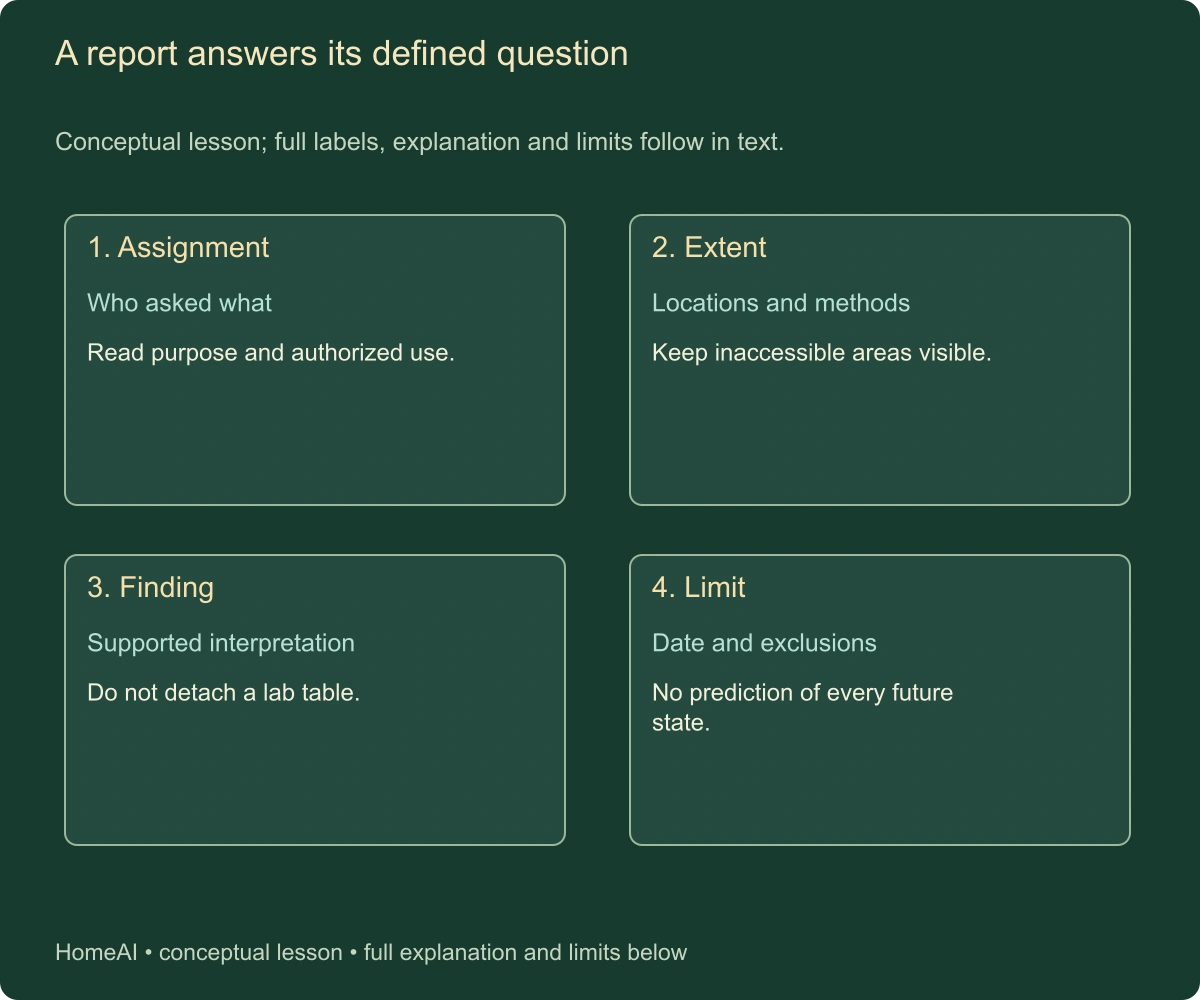
- Assignment
Who asked what. Read purpose and authorized use.
- Extent
Locations and methods. Keep inaccessible areas visible.
- Finding
Supported interpretation. Do not detach a lab table.
What does this illustration leave out?
No exposure pass mark, individual health advice or whole-house certification. This illustration explains an idea. It is not an installation guide.
Which actual documents and qualified advice resolve the distinction?
Explore this with HomeAI ↗Opens an editable question. Nothing is sent until you choose to send it.A report answers its defined question
Conceptual lesson; full labels, explanation and limits follow in text.
- Assignment
- Who asked what. Read purpose and authorized use.
- Extent
- Locations and methods. Keep inaccessible areas visible.
- Finding
- Supported interpretation. Do not detach a lab table.
- Limit
- Date and exclusions. No prediction of every future state.
Sampling, observation and interpretation stay within the actual engagement; an air result is not medical clearance.
What remains unknown: No exposure pass mark, individual health advice or whole-house certification.
A useful question: Which actual documents and qualified advice resolve the distinction?
Reinstatement can change more than the appearance
Rebuilding after damage can involve finishes, insulation, framing, windows, plumbing, electrical work or other systems. Identify what actually changed before asking which drawings, approvals, inspections and commissioning records should exist. A restoration contractor's invoice is not a substitute for the applicable authority's records or the appropriate trade's verification.
Ask whether the final arrangement matches the documented authorized scope. If a basement was reconfigured during restoration, distinguish repair of damage from the separate alteration. A new room layout may raise use, egress, ventilation or other questions for the actual authority and professionals. This guide does not determine permit requirements across Canada.
Where a system was removed, repaired or replaced, obtain the relevant model, installer, operating information and completion evidence. Confirm who assessed interfaces with retained equipment. A new component can be useful, but its age alone does not prove that the connected system was tested or that earlier deficiencies outside the project were resolved.
The renovation-permit and commissioning guides provide the wider record enquiries. Here the specific task is to connect each restoration change to those records. A final municipal inspection should retain its exact scope and date; it should not be marketed as an environmental clearance or a warranty against future moisture.
Also ask what maintenance changed. A revised drainage detail or replacement ventilation component may create operating tasks for the next owner. The handover should explain those tasks through the actual provider's instructions, not generic maintenance intervals invented for every restored property.
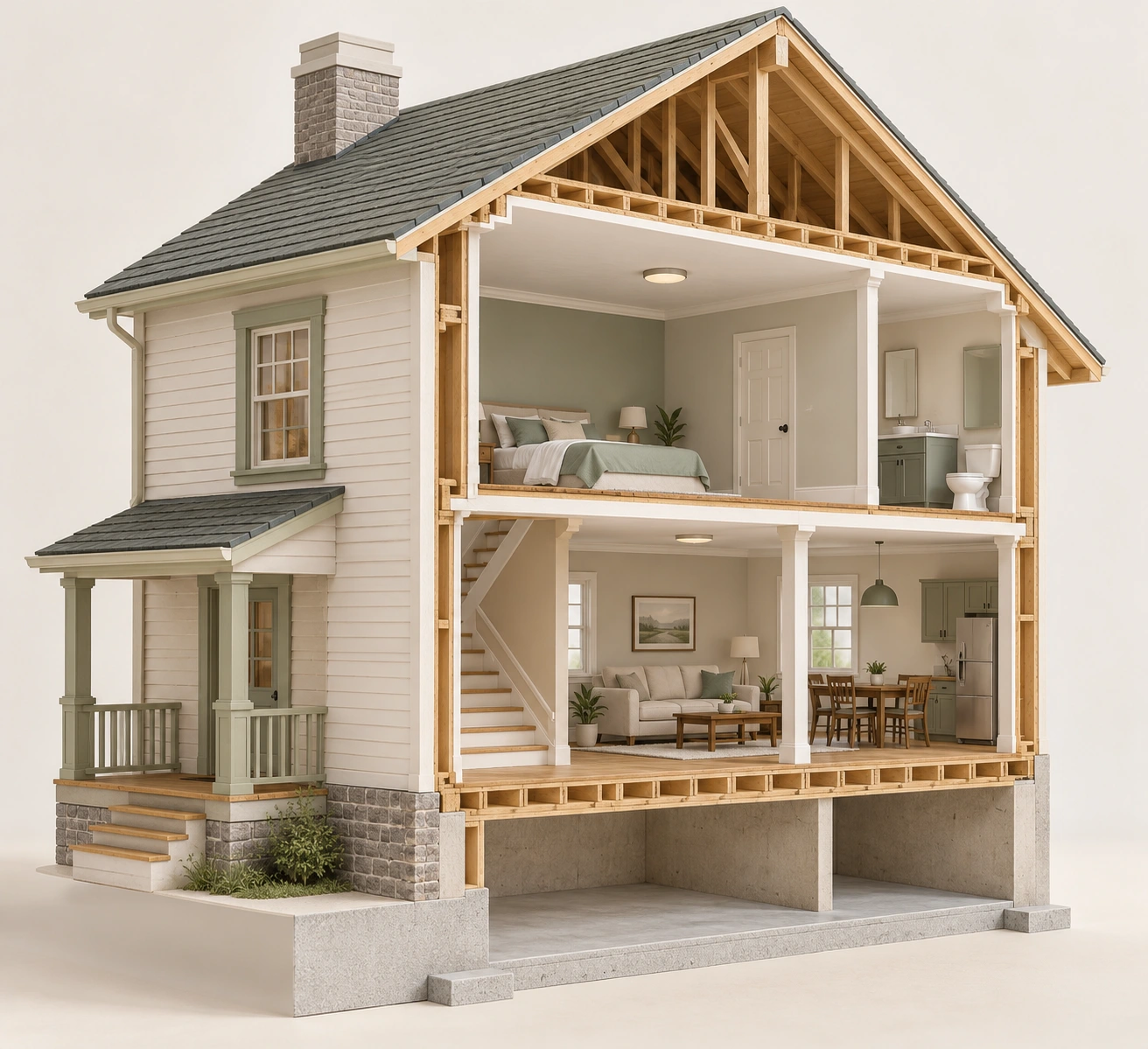
Was the initiating source assessed separately from reinstatement
Intact roof/exterior and uniformly finished interior in a generic cutaway; no initiating-source finding or repaired-performance proof.
Numbers identify the parts explained below.
- Visible context
Intact roof/exterior and uniformly finished interior in a generic cutaway; no initiating-source finding or repaired-performance proof.
- Limit
Conceptual generated context. No actual property, installed design, topology, measured performance, approval, ownership or responsibility established.
What does this illustration leave out?
Conceptual generated context. No actual property, installed design, topology, measured performance, approval, ownership or responsibility established. This illustration explains an idea. It is not an installation guide.
Was the initiating source assessed separately from reinstatement?
Explore this with HomeAI ↗Opens an editable question. Nothing is sent until you choose to send it.Was the initiating source assessed separately from reinstatement
Intact roof/exterior and uniformly finished interior in a generic cutaway; no initiating-source finding or repaired-performance proof.
What remains unknown: Conceptual generated context. No actual property, installed design, topology, measured performance, approval, ownership or responsibility established.
A useful question: Was the initiating source assessed separately from reinstatement?
Separate the insurance settlement from the completed property
IBC's flood-and-insurance guidance repeatedly directs households to the actual policy and insurance representative. Water-related coverages can differ, including overland water and sewer backup. A previous claim being accepted or paid does not establish the next buyer's coverage, future premiums, exclusions or ability to obtain insurance for the proposed use.
A settlement also has a different purpose from a technical completion finding. Money may have been paid under a policy, an estimate may have been negotiated and the owner may have selected work within that arrangement. Ask what was performed and documented rather than assuming the settlement amount equals a completed restoration scope.
For a seller, identify any relevant ongoing claim or unresolved work through authorized legal and insurance advice. For a buyer, obtain the property information needed by the proposed insurer and answer its questions accurately. Do not assume the seller can transfer a policy, claim rights, contractor relationship or remaining payment entitlement as part of the home sale.
IBC's page includes generalized filing periods and other numeric statements. This guide adopts none as a legal deadline for the reader. Actual policy conditions, dates and jurisdiction-specific advice control. The transaction should surface a timing question early enough for the appropriate adviser to resolve it rather than relying on a generic website summary.
Keep the insurance decision in writing to the extent the provider offers it, including assumptions, required work and effective timing. A quote based on incomplete event history is not the same as confirmation based on accurate property information. Any unresolved insurer requirement belongs in the transaction's open-issues list.
Payment and performed work are separate
Four evidence types perform different jobs in the restored-home transaction.
Numbers identify the parts explained below.
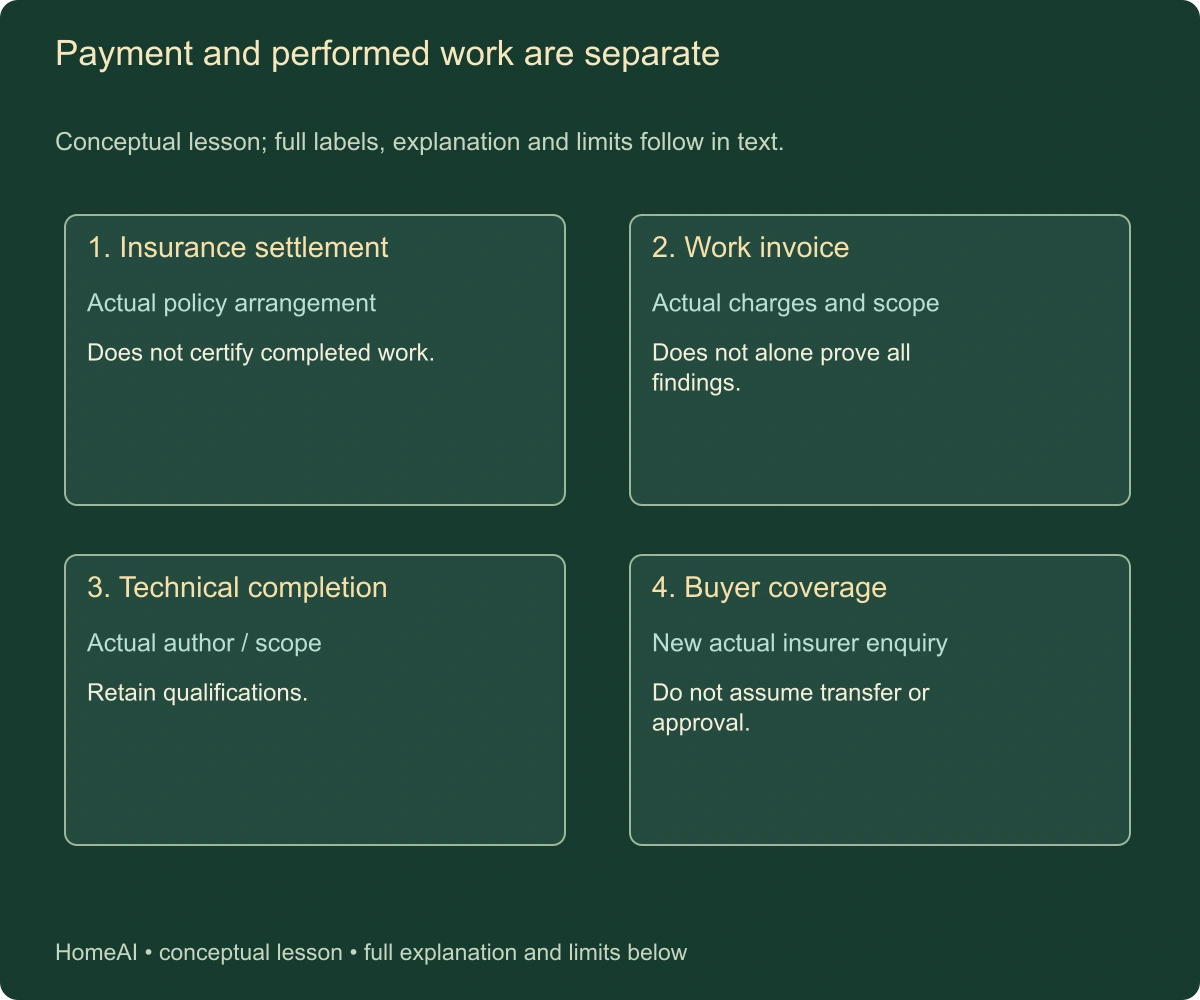
- Insurance settlement
Actual policy arrangement. Does not certify completed work.
- Work invoice
Actual charges and scope. Does not alone prove all findings.
- Technical completion
Actual author / scope. Retain qualifications.
What does this illustration leave out?
No claim entitlement, future coverage, legal deadline or repair certification. This illustration explains an idea. It is not an installation guide.
Which actual documents and qualified advice resolve the distinction?
Explore this with HomeAI ↗Opens an editable question. Nothing is sent until you choose to send it.Payment and performed work are separate
Conceptual lesson; full labels, explanation and limits follow in text.
- Insurance settlement
- Actual policy arrangement. Does not certify completed work.
- Work invoice
- Actual charges and scope. Does not alone prove all findings.
- Technical completion
- Actual author / scope. Retain qualifications.
- Buyer coverage
- New actual insurer enquiry. Do not assume transfer or approval.
Four evidence types perform different jobs in the restored-home transaction.
What remains unknown: No claim entitlement, future coverage, legal deadline or repair certification.
A useful question: Which actual documents and qualified advice resolve the distinction?
Price remaining work and uncertainty separately
Use one consistent property state for each proposed comparison. A quote prepared before demolition, a quote prepared after investigation and an invoice for completed work are not three interchangeable prices for the same finished result. Mark the stage and assumptions in the comparison so a difference in amount does not conceal a difference in knowledge or scope.
Ask which associated tasks sit outside a specialist's proposal. The environmental assessment may exclude reconstruction; a reconstruction proposal may exclude the earlier source repair; a trade's work may exclude other systems. The household needs a reconciled total scope from the actual providers, without expecting one provider to certify work beyond its engagement. Keep any gap visible rather than filling it with a generic percentage.
If the buyer intends further renovation, distinguish that elective project from work needed to address the identified concern. Combining them can make the restoration appear more expensive than its defined scope or conceal necessary work inside a discretionary design budget. The actual advisers can help separate purpose, sequence and dependencies. A preferred finish is a household choice; an unresolved moisture source remains a technical question.
A restoration can include completed work, known unfinished tasks and unresolved scope. Estimate these categories separately. A contractor's quote for new flooring may price a defined task, while an unanswered cavity question can affect whether that task is sufficient. Combining everything into a single guessed repair allowance conceals the difference.
Ask what evidence would narrow the uncertainty and what obtaining it involves. An assessment fee, access arrangement and timing may be more useful initially than an unsupported large contingency. Conversely, a small inspection budget should not be mistaken for a ceiling on whatever work the investigation might identify.
Where there are actual proposals, compare their location, method, exclusions, reinstatement, authority work and follow-up evidence. A cheaper quote that stops before reconstruction is not directly comparable with one that includes it. Keep sales taxes, access constraints and temporary accommodation questions within the relevant actual professional or provider advice.
An allowance or price reduction changes the financial bargain; it does not correct a defect, establish safe occupancy or ensure a lender or insurer will accept the property. A holdback may serve a defined legal arrangement if professionally drafted, but this guide provides no default wording, amount or right to retain sale proceeds.
The household can compare a documented restored home, a home needing defined further work and another property without this history. Each has its own condition and cost enquiry. The fair comparison uses evidence and actual household capacity rather than either a blanket stigma or an assumption that new finishes deserve a premium.
Resolve transaction responsibilities before relying on a promise
List each remaining item with the person expected to act, the evidence required and the timing that matters to the agreement. The seller, restoration provider, consultant, insurer, municipality and lender can each control different decisions. A buyer's request to one party cannot make another party approve work or release a report.
Ask the legal adviser how the actual agreement should address disclosures, representations, document delivery, access, unfinished work and any assigned rights. Local law and the particular contract matter. This guide does not state a universal Canadian seller-disclosure obligation or suggest that silence creates a safe legal conclusion.
Warranty language needs the same discipline. Identify who issued it, what work or product it covers, its exclusions, dates, transfer conditions and the process for a future concern. A product warranty may differ from a workmanship warranty, and neither automatically covers the cause of the original damage or every retained assembly.
If a promise cannot be verified before the relevant contractual decision, retain it as unresolved. The parties may obtain advice about additional time or another arrangement, or the buyer may decide the uncertainty is incompatible with proceeding. A salesperson's summary of intended future work should not be silently converted into performed-work evidence.
Before closing, ask which final documents and current observations have changed since the initial review. A new leak, a completed repair or an insurer condition may affect the decision. The transaction record should show the updated state rather than freezing an earlier reassuring summary after the facts have moved.
Check the present home and the permitted use of old reports
Historical restoration evidence is valuable, but the transaction still needs a present-condition enquiry. Ask an appropriate inspector or specialist what can be assessed now, what depends on concealed information and whether later observations change the earlier account. An old completion date and a current viewing date should never merge into a single undated statement that the house has been checked.
Compare current observations with the restoration boundary. A new stain outside the recorded area may concern another source; a symptom within it may need investigation without immediately proving that every earlier task failed. Record location, date and conditions and ask the relevant professional to interpret them. The buyer should not conduct water testing, open energized equipment or disturb potentially contaminated material to create evidence.
Ask the author of a prior report whether its intended use permits this buyer, lender or insurer to rely on it. The original engagement may have been for a contractor's particular stage or the seller's own information. Access to a PDF is not the same as authorized professional reliance. A new engagement or written clarification may be appropriate, depending on the actual report and adviser.
Keep the assessor's independence visible without using it as a substitute for competence and scope. An inspector engaged by the buyer can provide a different perspective, but may still be unable to observe concealed work. A specialist may have deeper knowledge of one system while excluding another. The useful record says who examined what and under which limitations, rather than merely listing professional titles.
The condition immediately before closing can also matter. If access is authorized, use the appropriate agreed process to confirm outstanding work and note material changes since the earlier review. A seller's new repair receipt should be reconciled with the open item it addresses. Where a new concern arises, seek professional and legal advice on the actual agreement; the guide does not create a right to reopen, delay or cancel a sale.
An accurate final summary can contain both confidence and limits: identified work has specified completion evidence, the present assessment reports these findings, and these inaccessible or unresolved matters remain. The household can then evaluate whether those limits fit its needs and resources. That is a stronger decision than requiring a professional to promise that no hidden issue can exist.
Fictional case: Rowan compares a finished room with the restoration scope
Rowan considers a house whose lower level has new wall finishes and flooring. The seller describes a past plumbing escape and provides a paid restoration invoice, several demolition photographs and a short completion letter. This is a fictional decision example; it establishes no actual home condition, insurance result or legal obligation.
Rowan's first question is not whether the room looks new. It is whether the records connect the reported leak, affected boundary and completed work. The invoice identifies two rooms, while one photograph appears to show an adjoining storage area opened during the response. Rowan records that discrepancy without concluding that the storage area is either damaged or remediated.
With authorized access to the relevant documents, an appropriate adviser asks the provider to clarify the final scope and the basis for reinstatement. The completion letter concerns the described remediation work, so Rowan keeps it separate from the plumbing repair record and the proposed insurer's questions. The example does not invent a favourable answer to any of them.
Suppose the seller offers a fictional $4,000 reduction for unfinished trim and cleaning. Rowan treats that as a proposed financial term, not an allowance that resolves the scope discrepancy. If the defined finishing task costs a fictional $2,500, the arithmetic leaves $1,500 of that reduction before other costs; it places no limit on an unresolved technical issue and predicts no market value.
Rowan can proceed only on the actual agreement and advice, seek further investigation or choose another home. The useful outcome is a separated decision: defined finishing work, clarification of restoration scope, current insurer review and household suitability each have their own evidence. New flooring no longer carries all four conclusions.
Handover the evidence and the remaining questions
Create a concise restoration index that the next owner can navigate: event chronology, affected-area plan, investigation, source repair, remediation, drying records, reinstatement, approvals, system information, relevant warranties and subsequent observations. Include each original author's qualifications and attach the relevant complete documents through authorized sharing.
Keep open items visible. A missing attachment, unresolved interface or pending insurer requirement should not disappear because closing is approaching. Identify the question, responsible adviser or provider, current evidence and next action. This is more useful than a generic statement that the buyer has been told about a past event.
The owner should know how to report a new symptom and which actual providers or authorities to contact. New moisture, odour or damage deserves assessment in its own context; it should not automatically be dismissed as part of an old resolved claim or assumed to prove failure of the entire restoration.
Retain records safely and preserve privacy when sharing. A future buyer may need property evidence without needing unrelated personal or financial details. Authorized redaction can protect those details while keeping the technical scope and limitations intelligible; it must not remove information essential to understanding the finding.
The transaction is ready for a decision when the household and its advisers understand what the restoration evidence supports, what it does not support and which remaining matters affect proceeding. The printable companion preserves these distinctions. Illustrations explain spaces and evidence relationships; they certify no actual repair, safety, health or coverage outcome.
Keep learning about the connected parts
- After a home flood: understand the recovery before the room looks finished
- Why damp walls and mould keep coming back
- Renovation records: what was proposed, approved and built?
Canadian context and authorities · Visual atlas · Learning labs
Practice the distinction.
Fictional case: Rowan compares a finished room with the restoration scope
Rowan considers a house whose lower level has new wall finishes and flooring. The seller describes a past plumbing escape and provides a paid restoration invoice, several demolition photographs and a short completion letter. This is a fictional decision example; it establishes no actual home condition, insurance result or legal obligation.
Reported observations
- Rowan's first question is not whether the room looks new. It is whether the records connect the reported leak, affected boundary and completed work. The invoice identifies two rooms, while one photograph appears to show an adjoining storage area opened during the response. Rowan records that discrepancy without concluding that the storage area is either damaged or remediated.
- With authorized access to the relevant documents, an appropriate adviser asks the provider to clarify the final scope and the basis for reinstatement. The completion letter concerns the described remediation work, so Rowan keeps it separate from the plumbing repair record and the proposed insurer's questions. The example does not invent a favourable answer to any of them.
A useful next question
Rowan can proceed only on the actual agreement and advice, seek further investigation or choose another home. The useful outcome is a separated decision: defined finishing work, clarification of restoration scope, current insurer review and household suitability each have their own evidence. New flooring no longer carries all four conclusions.
Know what the words mean.
- Source control
- Work directed at the cause of damage.
- Remediation
- Defined treatment or removal of affected material within an actual scope.
- Reinstatement
- Rebuilding the components and finishes for the intended use.
- Drying record
- Evidence of particular measurements and decisions, with methods and limits.
- Completion statement
- An author’s finding within a defined engagement and scope.
- Settlement
- The actual insurance financial arrangement, distinct from performed work.
- Authorized reliance
- Permitted use of a report under its actual engagement.
Questions to bring
to the conversation.
- Do the event history, affected-area plan and final work records explain the same locations and moisture source?
- What evidence supports source correction, remediation/drying and reinstatement separately, and which inaccessible or unresolved areas remain?
- What do present assessment, report-reliance advice, actual insurance terms and scoped remaining work mean for this transaction?
Separate a showing observation, an existing record and a new professional assessment. Unknown means a question remains; it does not automatically mean a defect.
Use the evidence planner ↗Go to the source.
Original HomeAI explanation informed by these public references. Sources support the underlying guidance; they have not reviewed or endorsed HomeAI. Diagrams are conceptual, and calculator outputs depend on your inputs.
Primary Canadian bodies read October 14, 2026 with recorded editions and jurisdiction limits. Historical sources and unread/access-held bodies are explicitly distinguished. Illustrations and fictional cases establish no actual condition, legal, health, coverage, financing or completion result. Actual documents and qualified advice control.
Publication & source review
First published .
Sources reviewed .
Have a question about your home?
Start with the symptom, timing and what you have observed.
Ask HomeAI